
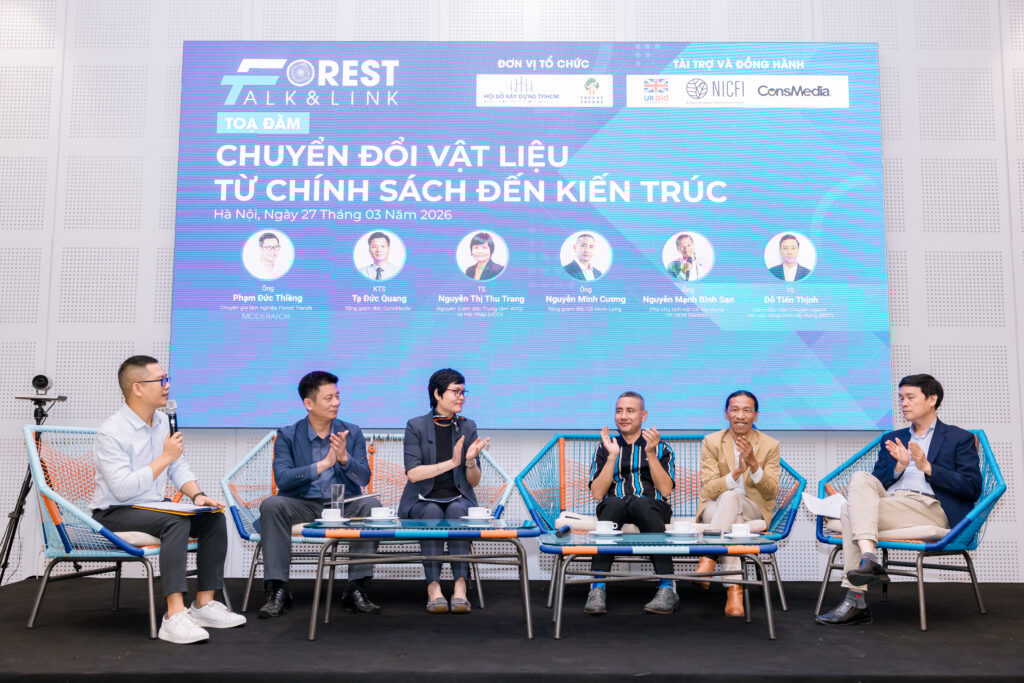
The green transition is increasingly becoming a new reference framework, requiring the entire construction industry to adapt—especially in material selection to ensure sustainability.
Green pressure reshaping materials and the role of wood
Speaking at the seminar “Material Transition – From Policy to Architecture” on the morning of March 27, Mr. Vo Quang Ha, Chairman of the Ho Chi Minh City Structural Wood Association (SAWA), stated that building materials are now under direct pressure from the need to reduce emissions, use resources efficiently, and meet sustainability criteria.
In this context, materials are no longer just a technical choice but a decisive factor throughout the entire lifecycle of a building—from design to operation.
The seminar therefore went beyond dialogue, aiming to connect stakeholders across the entire value chain—from policymakers and research institutions to businesses, architects, and designers—to bridge the gap between policy and practical implementation.
In reality, green pressure has been driven strongly by international markets. Dr. Nguyen Thi Thu Trang, former Director of the WTO and Integration Center (VCCI), pointed out that “greening” is no longer optional but a mandatory condition for businesses wishing to participate in global supply chains. These requirements come from both government regulations and consumer preferences.
Many countries are tightening regulations on construction materials, focusing on three key criteria: emission reduction, promotion of the circular economy, and ensuring legal, traceable supply chains. At the same time, consumers increasingly favor environmentally friendly, health-conscious products that are cost-efficient and aligned with sustainable lifestyles.
The European Union (EU) is seen as a leading force in this trend through initiatives such as the European Green Deal, the EU Deforestation Regulation (EUDR), and the Carbon Border Adjustment Mechanism (CBAM). In this context, new wood materials such as CLT, Glulam, and composite wood are considered advantageous due to their lower emissions, traceability, and potential to replace traditional materials like steel and cement.
In addition, circular economy principles are being widely applied. Materials are now expected to meet requirements for recyclability, reusability, waste reduction, and energy optimization throughout the building lifecycle.
In Vietnam, the material transition is gradually being promoted. Several policies have been explored, including tax incentives for environmentally friendly materials, green public procurement, and requirements to integrate sustainability criteria into bidding processes and technical standards. However, the transition still requires stronger support in areas such as green finance, technology transfer, workforce training, and market expansion for green materials.
“Awareness is also a key factor,” Dr. Trang emphasized, noting that understanding new materials requires the participation of multiple stakeholders—from architects and businesses to regulators—through communication, training, and industry seminars. The greening of the entire supply chain requires the combined efforts of three key pillars: people, technology, and policy.
Opportunities and restructuring pressure for the wood industry
The shift toward green materials opens up significant growth potential, but not for outdated business models. According to Mr. Nguyen Minh Cuong, CEO of Minh Long Wood Company, the wood industry still largely operates under a processing model with low added value and profit margins, and has yet to build strong international brands despite its high export value.
Many recyclable and low-emission materials were showcased at the seminar.
Photo: Phuc Tran.
In addition to external factors such as geopolitical fluctuations, which increase logistics and raw material costs, as well as technical and trade barriers, the industry also faces internal pressures. These include rising labor costs due to an aging population and increasing competition from cost-competitive countries such as India and Indonesia, gradually eroding Vietnam’s competitive advantage.
Mr. Cuong also noted that most value-added activities lie in downstream stages such as branding and distribution, while manufacturing accounts for only a small share of the final retail price. To address this, some enterprises have begun shifting toward developing new materials and products, such as antibacterial wood, low-emission materials, and products suitable for tropical climates.
The goal is to improve production efficiency while meeting increasingly diverse market demands.
From a design and construction perspective, architect Ta Duc Quang, CEO of ConsMedia, emphasized that the pressure goes even deeper, requiring a shift in industry mindset. The construction sector currently accounts for up to 37% of global emissions, with traditional materials like steel and concrete contributing significantly.
Engineered wood, particularly mass timber, is seen as a promising solution. According to Mr. Quang, this material can reduce emissions by approximately 40% compared to traditional materials, while also acting as a “carbon sink” capable of storing over 900 kg of CO₂ per cubic meter of wood.
Beyond environmental benefits, it also offers technical and construction advantages, including reducing structural weight by up to 80%, shortening construction time by around 20%, and potentially lowering investment costs by about 10% compared to conventional methods.
However, in Vietnam, the application of these new materials remains limited. The use of engineered wood in construction is still minimal, with most mass timber projects relying on imported components.
According to Mr. Quang, the reasons include the lack of a complete system of standards and technical regulations, particularly in areas such as fire safety and structural requirements. There is also a lack of tools to evaluate long-term economic efficiency, leading investors to focus primarily on initial costs rather than lifecycle costs. Additionally, practical experience in technical aspects such as material connections and moisture control remains limited.
Therefore, the material transition in the construction industry depends not only on technology but also on a fundamental shift in design thinking—from the conceptual stage to on-site implementation.