

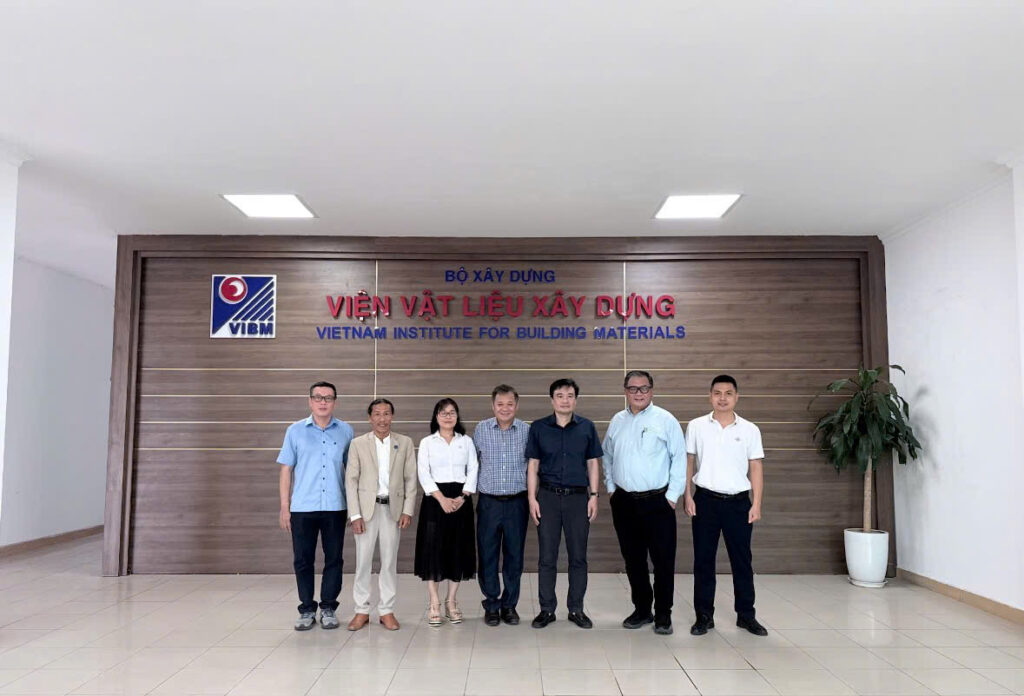
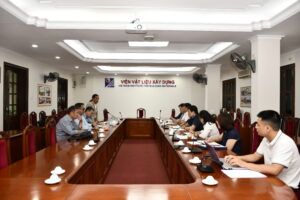
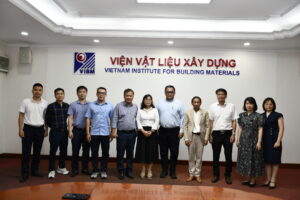
On the afternoon of 26 June 2026, the Institute of Building Materials (VIBM) under the Ministry of Construction held a working session with the Ho Chi Minh City Wood Construction Association (SAWA) and the Softwood Export Council (SEC) to exchange technical expertise, share industry insights, and discuss strategic cooperation in research, standardization, and the development of timber construction materials.
Attending the meeting on behalf of VIBM were Mr. Nguyen Quang Hiep, Director General; Ms. Luu Thi Hong, Deputy Director General; Mr. Cao Tien Phu, Head of the Planning and Technical Department; Mr. Nguyen Van Doan, Director of the Cement and Concrete Research Institute; Ms. Tran Thi Thu Ha, Director of the Certification Office, together with VIBM researchers. Representing SAWA were Mr. Vo Quang Ha, Chairman, and Mr. Nguyen Manh Binh San, Vice Chairman. The SEC delegation included Mr. Xu Fang, Asia Regional Director, and Mr. Vo Manh Hung, SEC Representative in Vietnam.
In his opening remarks, Mr. Nguyen Quang Hiep emphasized that, in the context of green transition and the growing demand for low-carbon construction materials, establishing a comprehensive technical standards system for structural timber is essential to support research, design, manufacturing, testing, and the application of timber products in construction projects.
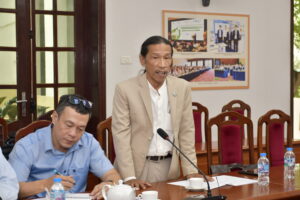
Sharing the same perspective, Mr. Vo Quang Ha, Chairman of SAWA, stressed that standards are not only technical tools but also the foundation of the market. He noted that developing a comprehensive system of Vietnamese standards for structural timber is a prerequisite for advancing timber construction in Vietnam—from residential housing and public buildings to future Mass Timber projects. Building such standards will not only strengthen the country’s technical framework but also lay the foundation for the sustainable growth of Vietnam’s timber construction market.

During the meeting, VIBM presented an overview of the current status of Vietnam’s timber construction standards, its roadmap for developing new Vietnamese Standards (TCVN) for structural timber, and the Institute’s testing and research capabilities to support quality management and market development. Based on this presentation, participants exchanged views on the existing gaps in the national standards system, international experience in structural timber development, and potential areas of cooperation to accelerate the establishment of Vietnam’s structural timber standards.
STANDARDS GAP – A MAJOR BARRIER TO THE DEVELOPMENT OF STRUCTURAL TIMBER AND MASS TIMBER IN VIETNAM
Although Vietnam is one of the world’s leading producers and exporters of wood products, its standards system for timber construction has yet to keep pace with the industry’s development. Most existing Vietnamese Standards (TCVN) focus on general timber products, including sawn timber, wood-based panels, finger-jointed timber, furniture, and testing methods, while standards specifically addressing structural timber remain limited. In particular, Vietnam has yet to establish a comprehensive standards framework covering the design, construction, and acceptance of timber structures. The country also lacks a structural timber design standard equivalent to Eurocode 5 (EN 1995), dedicated standards for Cross-Laminated Timber (CLT), and guidance on the application of strength classes in structural design.
Furthermore, many foundational timber standards developed between 1971 and 1986 have not been updated to reflect current international practices. Vietnam has yet to establish a structural grading system for domestic timber species aligned with European approaches, meaning there is no standardized database linking timber species and their origin to strength classes used in structural engineering. As a result, plantation species such as Acacia, Eucalyptus, and Rubberwood still lack sufficient technical classification to support their broader application in modern timber structures.
On the other hand, Vietnam has developed a relatively comprehensive system of testing standards for evaluating the physical and mechanical properties of timber materials, many of which have been harmonized with ISO standards. This demonstrates that the country already possesses a solid foundation for material evaluation. However, further efforts are needed to develop standards governing structural design, construction practices, and quality management in order to establish a complete technical framework for structural timber and Mass Timber development.
STRATEGIC COOPERATION BETWEEN VIBM, SAWA AND SEC TO DEVELOP VIETNAM’S NATIONAL STANDARDS FOR STRUCTURAL TIMBER BY 2027
In response to these industry needs, VIBM, SAWA and SEC have agreed to establish a strategic partnership with the objective of completing eight priority Vietnamese National Standards (TCVN) for structural timber and engineered wood products by 2027. These standards are expected to cover terminology and classification, technical requirements for structural sawn timber, glued laminated timber (Glulam), Cross-Laminated Timber (CLT), Laminated Veneer Lumber (LVL), structural timber design, testing methods, environmental performance and emissions, as well as traceability and sustainability requirements.
These standards will provide the essential technical foundation for the design, manufacturing, testing, construction, and acceptance of modern timber buildings in Vietnam.
Under this cooperation framework, VIBM will serve as the technical lead responsible for research, testing, and the development of national standards. The Institute will oversee the review and revision of existing standards, conduct research and testing programs, and progressively harmonize Vietnam’s standards with internationally recognized practices.
SAWA will act as the coordinating organization, connecting government agencies, research institutions, universities, industry stakeholders, and international partners. The Association will facilitate industry participation through data sharing, technical consultation, and the practical implementation of newly developed standards across the construction sector.
Drawing on its extensive international experience in timber construction market development, SEC will contribute global expertise, technical advisory services, professional training, and access to international networks of specialists. Through this collaboration, SEC will help strengthen Vietnam’s research capacity and accelerate the development of a modern, internationally aligned standards system for structural timber.