

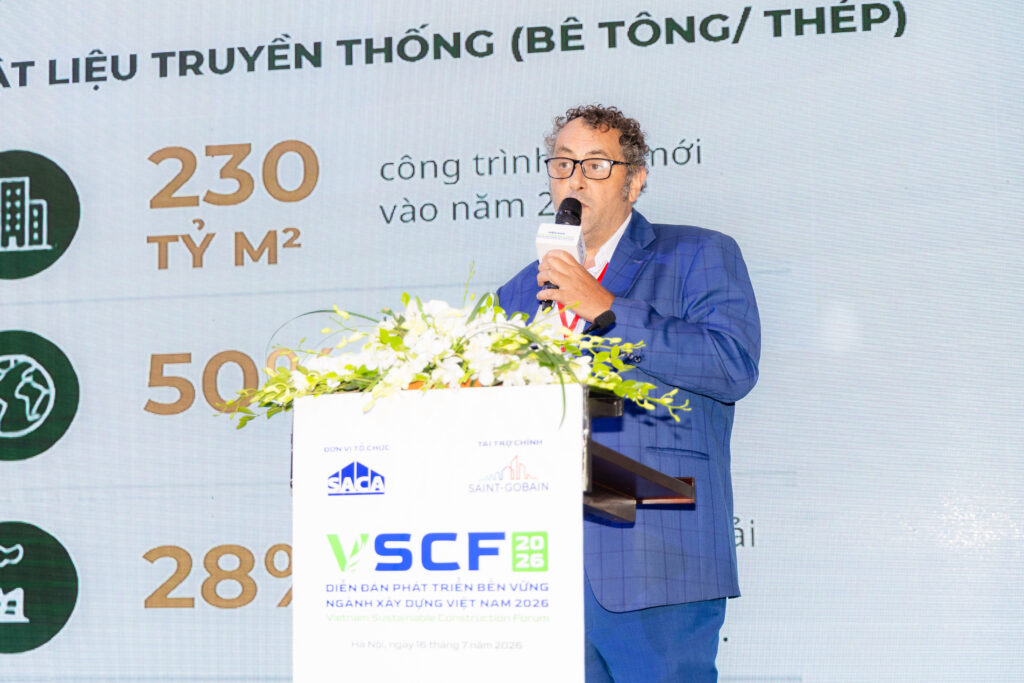
At the Vietnam Sustainable Construction Forum (VSCF 2026), held on 16 July 2026, Adam Corrall’s presentation, “Unlocking Green Finance Through Hybrid Mass Timber Construction,” raised a question that is becoming increasingly influential across the global construction industry: as investment capital increasingly favors projects that meet sustainability criteria, what will determine a company’s ability to access green finance?
From this perspective, Mass Timber is no longer viewed merely as an alternative to concrete or steel. Instead, its value lies in its ability to deliver buildings that simultaneously satisfy Environmental, Social and Governance (ESG) criteria—the standards that financial institutions and investors increasingly use to evaluate the quality and long-term viability of development projects.
From Building Material to Building Value
One of the central themes of the presentation was how Mass Timber creates value far beyond its role as a construction material. Rather than focusing solely on carbon storage, the presentation devoted significant attention to the impact of timber on occupant well-being and building performance.
Buildings constructed with Mass Timber offer considerable advantages in implementing Biophilic Design—an architectural approach that strengthens the connection between people and nature by incorporating natural elements into the built environment. Beyond aesthetics, numerous studies have shown that biophilic design can improve mental well-being, reduce stress, enhance concentration and increase workplace productivity. For developers, these benefits can translate into stronger commercial performance by improving user experience, increasing project attractiveness and enhancing long-term asset value.
Examples presented during the forum demonstrated that Mass Timber has already been successfully applied across a wide range of building types and climatic conditions. From residential developments in Africa and urban renewal projects in Melbourne, Australia, to vertical expansion projects in Minneapolis, United States, and industrial developments in São Paulo, Brazil, a common feature has been the integration of timber with concrete or steel to create hybrid structural systems. These systems reduce building weight, shorten construction schedules and improve operational efficiency. Such experiences suggest that Mass Timber has moved well beyond the experimental stage and is steadily becoming a practical solution for sustainable urban development.
Alongside its performance advantages, the presentation also addressed common concerns regarding the use of timber in construction, including moisture, termites and fire resistance. According to the technical solutions presented, these challenges can now be effectively managed through engineering standards, advanced material treatments and appropriate connection systems. This indicates that the principal barriers to Mass Timber today are no longer technological, but rather the ability of individual markets to establish standards and organize implementation.
ESG Data: The Key to Unlocking Green Finance
The most significant message of the presentation lay in the relationship between Mass Timber and green finance. As global investment trends continue to evolve, whether a building is considered “green” can no longer rely on general commitments or marketing claims—it must be supported by verifiable data.
Tools such as Life Cycle Assessment (LCA), Environmental Product Declarations (EPDs) and ESG metrics are increasingly becoming the basis on which financial institutions assess a project’s sustainability performance. When developers can demonstrate carbon emissions, resource efficiency, material traceability and broader social benefits, their opportunities to access green financing expand accordingly. In other words, data has become the common language connecting the construction industry with investors and financial institutions.
Within this context, internationally recognized frameworks such as the IFC Performance Standards, GRESB and EDGE were introduced as important tools for helping companies establish project evaluation and management systems aligned with global best practices. These frameworks are no longer simply desirable for sustainable development projects—they are becoming essential for companies seeking to strengthen their competitiveness in international markets.
From Global Trends to Vietnam’s Reality

While Adam Corrall’s presentation highlighted the opportunities that Mass Timber offers for accessing green finance, the subsequent discussion shifted attention to the practical realities facing Vietnam. According to Nguyễn Mạnh Bình San, Vice Chairman of the Ho Chi Minh City Structure Architecture Wood Association (SAWA), surveys conducted by SAWA indicate that several member companies are currently importing Mass Timber components directly from overseas at prices ranging from USD 400–600 per cubic metre for standard LVL and USD 900–1,200 per cubic metre for standard Glulam. By comparison, the estimated domestic production cost for Mass Timber currently ranges from USD 1,200–1,400 per cubic metre. Furthermore, the raw materials required for Mass Timber production are still largely imported from countries with well-established structural timber industries, including New Zealand, the United States, Canada and Russia.
Based on these realities, Mr. Bình San raised two questions directly to Architect Nguyễn Huy Hiển, Technical Director of Trần Đức Group, regarding the feasibility of developing Vietnam’s domestic Mass Timber manufacturing industry.
First, if Vietnam must also rely on imported raw materials to manufacture Mass Timber, where will the country’s competitive advantage come from, given that exporting countries already possess abundant timber resources, advanced manufacturing technologies and significantly lower production costs?
Second, Mass Timber is widely recognized as a low-carbon building material. However, if raw materials must first be shipped to Vietnam for manufacturing before the finished products are exported back to countries with established Mass Timber industries or other international markets, each product effectively undergoes two stages of international transportation. Under such circumstances, how should the overall carbon reduction benefits of the supply chain be evaluated?
Responding to the questions, Architect Nguyễn Huy Hiển explained that domestic timber species such as acacia and rubberwood currently do not satisfy the technical requirements for Mass Timber production. Consequently, manufacturers must continue importing structural timber, primarily Radiata Pine from New Zealand. However, he acknowledged that no satisfactory answer has yet emerged regarding either the industry’s cost competitiveness or the carbon implications associated with multiple stages of international transportation.
Green Finance Is No Longer a Future Concept
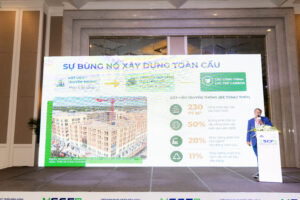
The presentation concluded by leaving the audience with a broader reflection—not only on the potential of Mass Timber itself, but also on the changing way the construction industry is being evaluated. Whereas building materials were once selected primarily on the basis of cost and technical performance, the value of a building is now increasingly measured by the environmental and social benefits it delivers—and by its ability to substantiate those benefits through transparent, verifiable data.
As ESG steadily becomes a global investment benchmark, Mass Timber represents more than a new direction for architecture and construction. It also serves as a bridge connecting the construction industry with the growing flow of green capital. For Vietnam’s structural timber sector, this represents an important opportunity to advance sustainable development while strengthening its integration into international markets.