

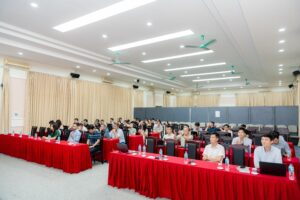
As part of the Vietnam Sustainable Construction Forum (VSCF 2026), the technical visit to the Prefabricated Timber Structure Demonstration House at the Institute of Building Science and Technology (IBST) on the afternoon of July 15, 2026, attracted significant interest from experts, businesses, and construction industry stakeholders. Certified to the EDGE Advanced standard, the building operates on 100% renewable energy, significantly reduces embodied carbon in construction materials, and is regarded as one of Vietnam’s representative models for low-carbon buildings.
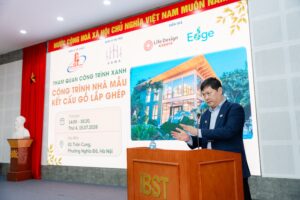
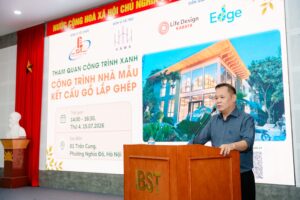
Representing the Organizing Committee, Mr. Phan Huu Duy Quoc, Vice Chairman of the Ho Chi Minh City Construction and Building Materials Association (SACA), emphasized that as the construction industry moves toward green development and the Net Zero target, exploring innovative building materials and construction technologies is no longer an option but an inevitable requirement. According to him, the IBST Demonstration House illustrates a new direction for Vietnam’s construction sector by integrating Japanese timber housing technology, prefabricated timber structures, and low-carbon building standards, opening the door to faster, lighter, and more sustainable construction solutions. He also expressed his expectation that the program would serve as a platform connecting businesses, experts, and research institutions, thereby accelerating the practical adoption of green construction solutions.
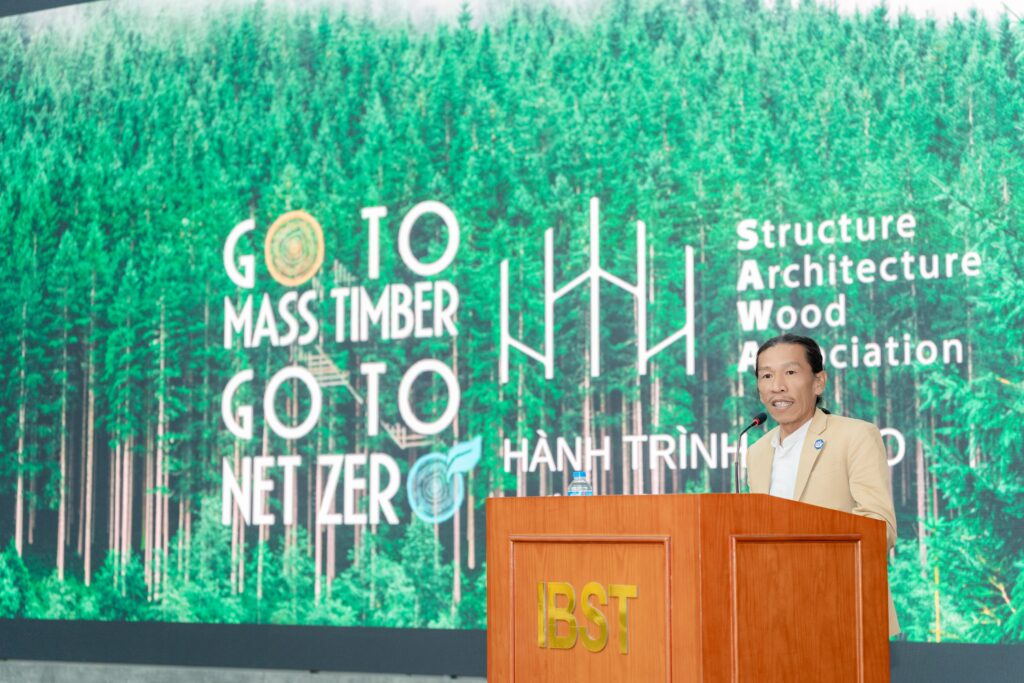
Among the program’s technical sessions, the presentation “GO TO Mass Timber – GO TO Net Zero” by Mr. Nguyen Manh Binh San, Vice Chairman of the Ho Chi Minh City Structural Architecture Wood Association (SAWA), offered a distinctive perspective on the future of timber construction in Vietnam. Rather than focusing solely on technology or products, his presentation stressed that the foundation for developing Mass Timber in Vietnam lies in changing public perception of timber construction. At the same time, standardization and international collaboration are essential pillars for building an integrated ecosystem and ensuring the industry’s sustainable development.
Changing Mindsets to Open a New Market
According to Mr. Binh San, Mass Timber and Net Zero remain relatively unfamiliar concepts for much of Vietnam’s construction industry. To bridge this gap, SAWA adopted the message “GO TO”, which carries a dual meaning. “Go To” represents the journey toward a greener future, while “Gỗ To” (literally “large timber”) refers to structural timber and Mass Timber. More than a communication slogan, it reflects SAWA’s long-term vision of positioning timber as a mainstream construction material in Vietnam.
Mr. Binh San pointed out that the greatest obstacle is not technology or manufacturing capacity, but rather the market’s perception of timber. For decades, wood has primarily been viewed as an interior finishing material or a forestry product. The concept of construction timber has yet to be fully recognized by architects, engineers, developers, and end users. Therefore, SAWA’s first mission has not been selling products, but changing mindsets.
This is the driving force behind the GO TO THINK initiative, which seeks to dismantle three long-standing misconceptions: that timber is expensive, that it lacks durability and structural reliability, and that using wood inevitably leads to deforestation and environmental degradation.
To address these misconceptions, SAWA has organized 12 specialized seminars along with two recurring programs aimed at redefining the role of timber in construction. According to Mr. Binh San, SAWA’s objective is not simply to introduce a new material, but to reposition construction timber as a major category of building materials comprising both architectural timber products and structural timber (Mass Timber).
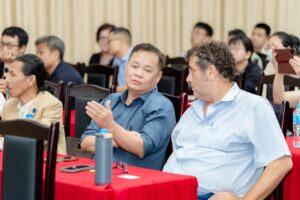
This effort has created a foundation for expanding timber applications beyond interior decoration into residential, commercial, and industrial construction, gradually transforming market perception.
The combined impact of the 12 GO TO Mass Timber seminars, together with the recurring Forest Talk & Link and Net Zero Café programs, has begun to reshape public understanding of timber consumption. Construction timber is increasingly recognized as a legitimate building material, while the use of responsibly sourced timber is now associated with environmental protection and the journey toward Net Zero.
This shift in perception has become a key driver of market growth. Major enterprises have started investing in the timber construction sector, demonstrating that it is evolving into a promising industry rather than remaining a niche market. Tavico, for example, is developing an open Depot-style timber construction supermarket, bringing together building materials from multiple manufacturers on a standardized platform similar to the Google/Android ecosystem. Alongside this is the One-Stop Solution model, represented by Tran Duc Homes, which provides integrated design, manufacturing, and construction services, comparable to the Apple iOS ecosystem.
According to Mr. Binh San, these two business models complement rather than compete with each other, illustrating the gradual formation of Vietnam’s timber construction ecosystem. SAWA’s vision is not to replace or compete with Vietnam’s existing construction ecosystem—which is already highly regarded internationally—but to integrate timber as an additional sustainable building solution that enriches the industry’s existing strengths.
These developments indicate that Vietnam’s timber construction market is moving beyond its experimental stage toward a more mature and professional phase. Architects, consultants, contractors, and developers are increasingly incorporating Mass Timber into their building designs and material specifications for future projects.
Standardization and International Collaboration – Building the Foundation for Vietnam’s Timber Construction Ecosystem
If changing perceptions is the starting point, standardization is the foundation for sustainable market development.
Mr. Binh San highlighted the distinction between Company Standards and Vietnam National Standards (TCVN). Company Standards enable individual manufacturers to ensure consistent product quality and demonstrate their commitment to customers. In many cases, these internal standards may even exceed national requirements. He encouraged enterprises to establish their own Company Standards as a way to overcome the long-standing perception that timber products lack consistency and reliability.
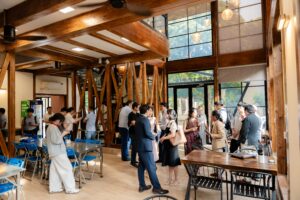
Meanwhile, SAWA’s role is to support government agencies and technical institutions in developing and improving the Vietnam National Standards (TCVN), while simultaneously encouraging its members to establish robust internal quality standards.
SAWA is currently collaborating with the Vietnam Institute for Building Materials (VIBM) to develop national standards for construction timber. The initial focus includes standards covering structural performance, durability, fire safety, material quality assessment, and conversion standards for imported timber components. In the next phase, SAWA aims to work with the Institute of Building Science and Technology (IBST) to develop design, construction, and inspection standards for timber structures, thereby establishing the technical and regulatory framework needed for Vietnam’s timber construction industry.
Building upon its efforts in awareness raising and standardization, SAWA also announced the next phase of GO TO EXHI – “Mass Timber House in Forest”. More than a conventional exhibition, GO TO EXHI is envisioned as an outdoor show-lab, where demonstration buildings constructed with CLT, Glulam, LVL, and other engineered timber systems will be built directly within a natural forest environment. The exhibition will showcase Mass Timber technologies while providing a real-world testing ground for design, construction, and material standards.
Looking further ahead, GO TO EXHI aims to establish a collaborative platform connecting businesses, architects, contractors, research institutions, universities, and the broader community to accelerate the development of sustainable timber architecture in Vietnam. The participation of VIBM is expected to provide strong scientific and technical support, linking research, standardization, and practical implementation.
From changing public perception and shaping the market to developing standards and strengthening international collaboration, the message “GO TO Mass Timber – GO TO Net Zero” outlines a clear roadmap for SAWA’s vision of Vietnam’s timber construction industry. It represents not only the introduction of a new building material, but also the creation of a scientific, technical, and social foundation that will enable construction timber to become an essential solution for green buildings, low-carbon development, and Vietnam’s long-term Net Zero ambitions.