
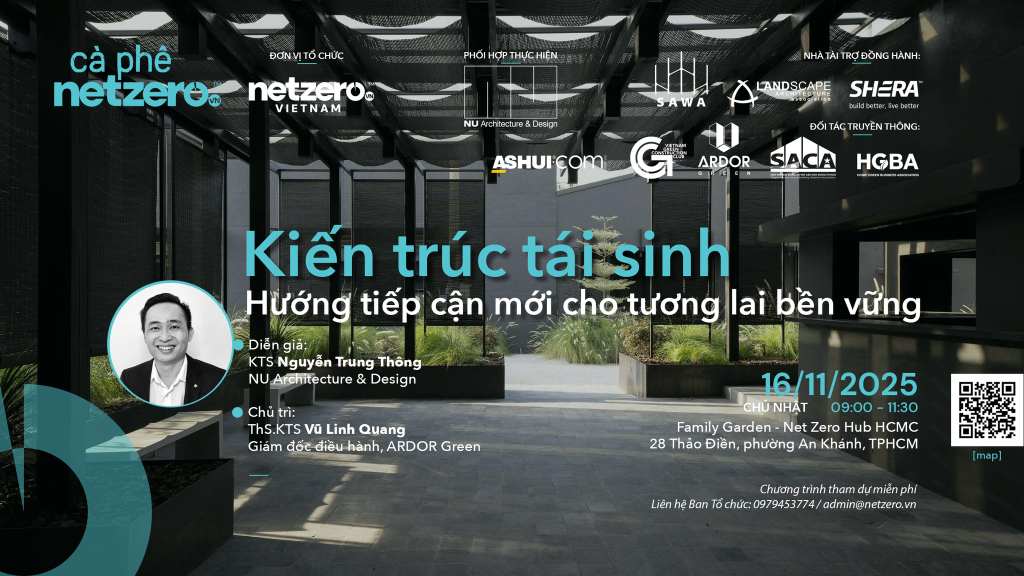
On Sunday morning, 16 November 2025, at Family Garden – Net Zero Hub HCMC (28 Thao Dien, An Khanh Ward, HCMC), the event Café Net Zero #27 will take place with the theme “Regenerative Architecture – A New Approach Toward a Sustainable Future.”
This is a recurring gathering for the architecture–construction–materials community, serving as an open forum to connect experts, exchange knowledge, and inspire solutions towards an environmentally responsible development model.
As a supporting partner, the Association of Structure Wood Architecture – Ho Chi Minh City (SAWA) affirms the commitment of the structural wood sector to actively participate in the regenerative architecture movement—where materials are not only structural components but also agents in restoring, regenerating, and connecting buildings, people, and the natural environment.
Regenerative Architecture: A New Approach Toward a Sustainable Future
“Regenerative architecture” represents an approach beyond conventional sustainable design. Rather than simply minimizing negative environmental impact, it aims to restore, revitalize, and enhance the adaptive and developmental capacities of ecosystems and communities.
At the event, participants will explore how architecture, materials, and buildings can be re-imagined to adopt a “living attitude” toward the environment—capturing rainwater, reusing materials, nurturing biodiversity, and fostering community engagement.
The core message is: “Not only building structures, but cultivating living ecosystems.”
Structural Wood – A Natural Direction for Regenerative Architecture
Within the regenerative architecture paradigm, structural wood emerges as one of the most suitable materials capable of fully participating in an open-loop life cycle of buildings.
Unlike conventional industrial materials whose life cycle is linear—from extraction to use to disposal—structural wood can move through multiple circular phases: from its initial use in buildings to reuse, recycling, or functional transformation.
With its biogenic nature, wood is formed via carbon absorption during tree growth. When responsibly sourced from sustainably managed forests, wood is considered a regenerative material because it maintains the cycle of “from forest to building—and back into the material ecosystem” through reuse.
In dense urban environments, where natural ecosystem restoration is difficult due to limited green space, utilizing structural wood as a regenerative agent through material recycling becomes a highly relevant and impactful strategy. Its flexibility—easy processing, assembly, disassembly, and transformation—allows wood components to be reused in new projects after their initial service life, aligning with the idea that “every material can be reborn in a new form.”
Furthermore, structural wood carries cultural value and urban memory. Reusing wood from older buildings to create new spaces preserves the city’s narrative, carrying past stories into contemporary living.
Re-processed wood elements can become interior components, sun-shading panels, or architectural façades—retaining both emotional and historical layers that allow new buildings to remain connected to their past context.
Regenerative practice with structural wood also enables diverse innovations, including:
-
Reusing original wooden components (beams, columns, panels)
-
Recycling into new products (e.g. laminated/engineered wood, interior elements)
-
Functional regeneration of buildings without full demolition
Combined with design-for-disassembly and future-adaptability strategies, structural wood becomes an ideal candidate for regenerative urban cycles. Buildings are no longer restricted to a single fixed lifespan—rather, they can be adapted to serve evolving community needs.
This approach reduces material waste, minimizes new production demand, lowers carbon emissions, and contributes to shaping a more sustainable urban environment.
In Vietnam, the increasing adoption of reclaimed/reused wood opens opportunities to develop a regenerative architectural language with local identity, where natural materials such as wood serve as bridges connecting nature, community, and urban memory.
For these reasons, structural wood is not only an environmentally friendly option—it is a meaningful medium that allows architecture to participate in the regenerative urban cycle: sustainable, expressive, and culturally rich.
This represents a promising direction for Vietnam’s structural wood sector as it joins the broader regenerative architecture movement.
Speakers & Program
Keynote Speaker
-
Architect Nguyễn Trung Thông – NU Architecture & Design
Experienced in adaptive architecture, material reuse, and the development of multiple practical projects in Vietnam and abroad.
Moderator
-
M.Arch. Vũ Linh Quang – Managing Director, ARDOR Green
With more than 15 years of experience in green building consultancy and sustainable architectural design.
Time
-
09:00 – 11:30, Sunday, 16 November 2025
Venue
-
Family Garden – Net Zero Hub HCMC
28 Thao Dien, An Khanh Ward, HCMC -
Register to join: https://bit.ly/caphenetzero27
Agenda
-
09:00 – Welcome, networking
-
09:30 – Keynote presentation
-
10:15 – Discussion & Q&A
-
11:00 – Networking session
-
11:30 – Closing
Organizer
-
Net Zero Vietnam JSC
Co-organizer
-
NU Architecture & Design
Supporting Partners
-
SAWA
-
Landscape Architecture Association
-
SHERA Vietnam
Media Partners
-
Ashui.com
-
Vietnam Green Building Club
-
ARDOR Green
-
Ho Chi Minh City Construction & Building Materials Association (SACA)
-
Ho Chi Minh City Green Business Association (HGBA)