
As Vietnam continues to promote sustainable construction, emissions reduction, and the use of environmentally friendly materials, engineered timber (structural wood / mass timber) is increasingly gaining attention as a promising development pathway. However, applying timber construction in tropical regions such as Vietnam still presents significant challenges related to hot and humid climates, heavy rainfall, and high requirements for durability, safety, and overall building performance.
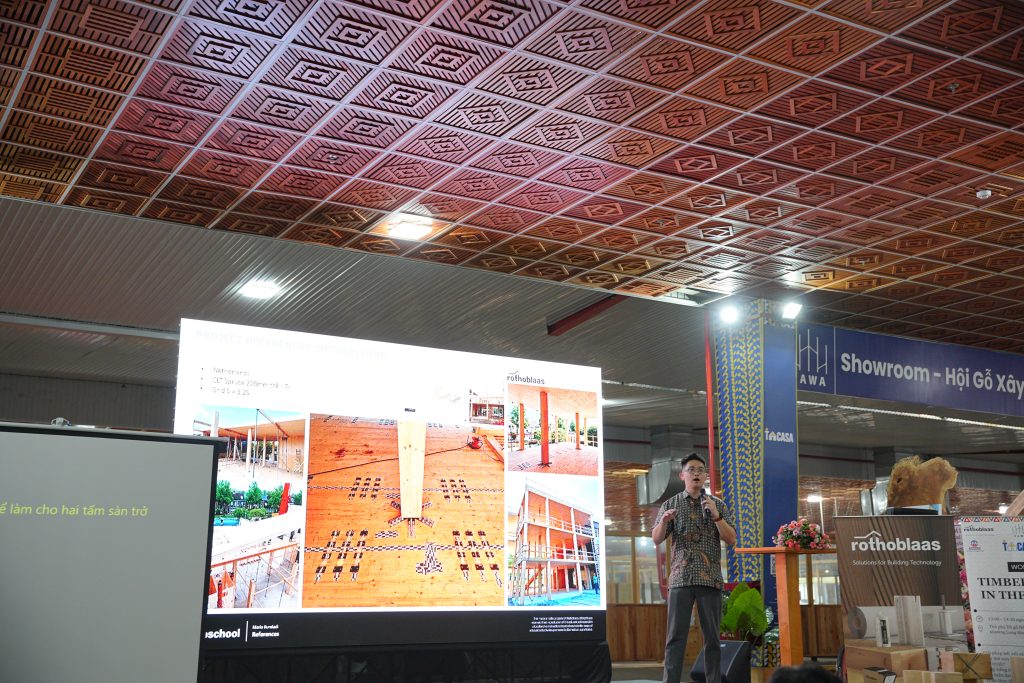
Ahead of the seminar “Wood Construction – Build the Future” organised by the Ho Chi Minh City Wood Construction Association (SAWA) on 12 December 2025, Mario Kurniadi, Area Sales Manager of Rothoblaas, led a technical pre-seminar workshop entitled “Timber Trend in the Tropics”. Designed as a foundational activity prior to the main seminar, the workshop focused on key technical aspects of timber construction, with particular emphasis on how timber buildings can effectively adapt to tropical climate conditions.
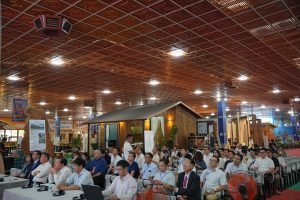
During the workshop, Mario Kurniadi highlighted that one of the most critical foundations of modern timber construction lies in the use of standardised structural connection systems. In engineered timber buildings—especially multi-storey and hybrid structures combining timber with concrete or steel—connections play a decisive role not only in assembling structural elements but also in determining load-bearing capacity, geometric accuracy, construction efficiency, and long-term safety. The use of tested, certified, and tightly quality-controlled connection solutions helps minimise construction risks while significantly improving the overall reliability of the structural system.
Another key topic addressed in the workshop was waterproofing and moisture control, a decisive factor affecting the longevity of timber buildings in tropical climates. Through the explanation of the SD value (water vapour transmission resistance), Mario Kurniadi emphasised that the correct selection and sequencing of material layers allow buildings to remain effectively protected against external moisture while still enabling internal vapour diffusion. Improper moisture management, he noted, may lead to condensation within the structure, negatively impacting timber quality and reducing long-term durability.
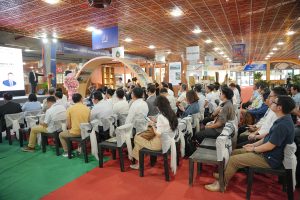
Fire performance in timber construction was also discussed from a scientific and practical perspective. According to Mario Kurniadi, when properly considered from the design stage and supported by appropriate technical solutions, timber structures can meet fire safety requirements, including those applicable to multi-storey residential buildings and public facilities. This approach is essential in addressing persistent concerns and misconceptions surrounding fire safety in timber construction across many Asian markets.
In addition, acoustic performance was examined through practical examples and on-site testing. Mario Kurniadi pointed out that impact noise and airborne sound transmission are often underestimated during the design of timber buildings. However, by applying suitable floor assemblies, resilient layers, and structural configurations, acoustic performance can be significantly improved, resulting in a more comfortable user experience in residential buildings, restaurants, hotels, and other public spaces.
Through this pre-seminar workshop, Rothoblaas provided architects, engineers, and industry stakeholders in Vietnam with a structured and practical understanding of the technical requirements for timber construction in tropical environments. Beyond preparing participants for the main seminar, the workshop also offered valuable insights and feasible approaches to advancing sustainable timber construction in Vietnam, aligned with local climate conditions and the evolving market context.