
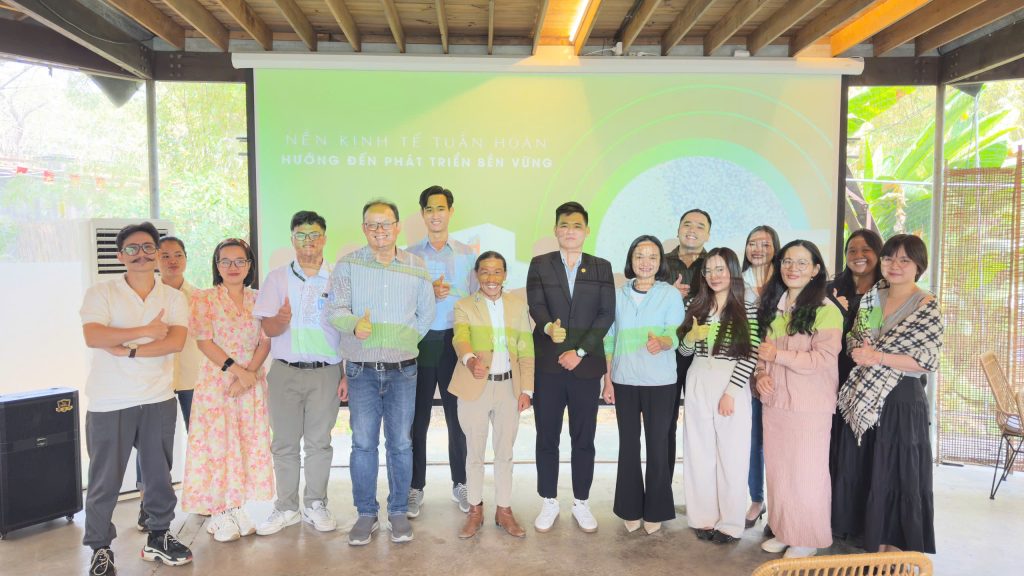
The Cafe Net Zero session held yesterday (18 January 2026), organised by Net Zero VN with SAWA as the supporting partner, focused on two key topics: the practical experience of building a sustainable operational model at Làng Nhỏ, and the challenges of developing the plastic recycling sector in Vietnam.
Instead of theoretical presentations, participants engaged directly with real-world implementation: learning from the application of international standards at a specific destination, and understanding the concrete operational and financial challenges faced by a company investing in recycling.
The two main presentations were delivered by Mr. Nguyen Manh Binh San, owner of Làng Nhỏ Eco-Tourism Village, and Mr. Le Viet Dong Hieu, Deputy Marketing Director of DUYTAN Group, representing Duy Tan Recycling. Although coming from two different sectors — tourism and recycling — both speakers converged on one central message: sustainability does not lie in declarations, but in how a business organises its operations, accepts the costs of transition, and remains consistent with long-term choices.
Làng Nhỏ and the lesson of “doing it for real” in the green transition

In his presentation, Mr. Nguyen Manh Binh San approached the topic of Net Zero not from theory, but from the concrete journey of Làng Nhỏ Eco-Tourism Village (Khanh Hoa) — the first destination in Vietnam to achieve the Good Travel Seal – Level 1 (Bronze) after an independent assessment conducted by international experts.
According to Mr. San, the greatest value of this journey does not lie in obtaining a certificate, but in the process that compelled the business to comprehensively review its entire operational system. The Good Travel Seal standard, built upon the framework of the Global Sustainable Tourism Council (GSTC) and recognised by UN Tourism and UNEP, does not evaluate what businesses claim, but measures what is actually happening in practice.
The assessment system is structured around 10 pillars and 62 criteria, covering all aspects of a destination’s operations — including resource management, waste, water, energy, labour, community engagement, cultural preservation, governance transparency and data management. This approach makes it impossible to rely on “green marketing”, and instead forces businesses to address their operational foundations: from internal procedures and data systems to their relationship with local communities.
Mr. San shared that one of the most significant changes at Làng Nhỏ was the need to build a system of operational evidence, rather than relying on subjective perceptions. The Good Travel Seal assessment requires documentation, data, operational logs, visual evidence, and on-site inspections — including direct observation and interviews with the operating team. In other words, the system measures “what is actually happening”, not “what is being promoted”.
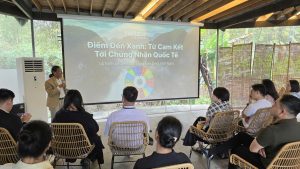
This process, he noted, forced the business to confront itself honestly: identifying what was being done well, what gaps had previously gone unnoticed, and what foundational changes were necessary to pursue sustainability in a meaningful way. From this experience, Mr. San argued that international standards should not be seen merely as “certification tools”, but rather as tools for assessing and reflecting a company’s true operational capacity.
From the story of Làng Nhỏ, he emphasised that sustainability only becomes meaningful when it evolves into an operational capability that influences the core systems of an organisation. When a business must adjust how it uses resources, manages waste, trains its people, manages data and ensures transparency, sustainability is no longer a message — it becomes part of the operational structure.
He also acknowledged that this path is not easy. Building a system that is sufficiently rigorous, transparent and consistent to withstand independent verification requires time, resources and persistence. However, it is precisely this process that creates long-term value, as it enables businesses to build a solid foundation rather than simply follow short-term trends.
Duy Tan Recycling: Choosing to “do it right from the beginning” in the recycling sector
If the story of Làng Nhỏ illustrates sustainability in tourism, the presentation by Mr. Le Viet Dong Hieu, Deputy Marketing Director of DUYTAN Group, offered a concrete perspective from the plastic recycling sector — a key pillar of the circular economy.

Representing Duy Tan Recycling, Mr. Hieu explained that the company was established with a clear purpose from the outset: to address plastic waste in Vietnam. This was not a strategic shift driven by trends, but a core mission embedded in the business model from the beginning. Entering the recycling sector meant accepting involvement in a difficult industry, requiring substantial investment and offering limited precedents of success in the domestic market.
A notable aspect of the presentation was the company’s openness in acknowledging that Duy Tan Recycling has not yet achieved profitability and has not reached its break-even point. According to Mr. Hieu, this reflects the reality of the recycling sector, where capital investment in technology, infrastructure and operations is high, while the market for recycled products and the supporting ecosystem are still developing. Nevertheless, the company continues to pursue this path, viewing it as a long-term commitment rather than a short-term opportunity.
In operational terms, Duy Tan Recycling identified the lack of waste separation at source as the most significant challenge — more problematic than technology itself. When waste is not properly separated from the beginning, the entire downstream process — collection, cleaning and recycling — is affected, leading to reduced efficiency and increased costs. This highlights that recycling cannot be solved by corporate capacity alone, but requires parallel changes in public awareness and consumer behaviour.
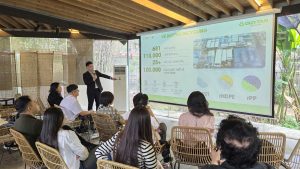
For this reason, Duy Tan Recycling places strong emphasis on market education and behavioural change, particularly among Gen Z, who are seen as a more responsible consumer group, more attentive to product origin, material life cycle and environmental impact. The company views this generation as an important driver in shaping a more sustainable consumption ecosystem in the future.
Throughout the presentation, one principle was repeatedly emphasised: doing things right from the beginning. According to Mr. Hieu, only by establishing the right foundations can Vietnam’s recycling sector develop sustainably, rather than relying on short-lived, trend-driven solutions.
When sustainability returns to its true meaning
Across two different sectors — tourism and recycling — a shared message emerged clearly: the path to sustainability is difficult, slow and costly, yet it is essential for businesses that seek long-term viability in a market increasingly defined by transparency and accountability.
The value of Cafe Net Zero therefore does not lie in the scale of the event, but in the quality of dialogue it fosters. Participants were not searching for quick formulas, but instead confronting practical questions: how their organisations truly operate, what impact they are creating, and how far they are willing to go on the path of transition.