
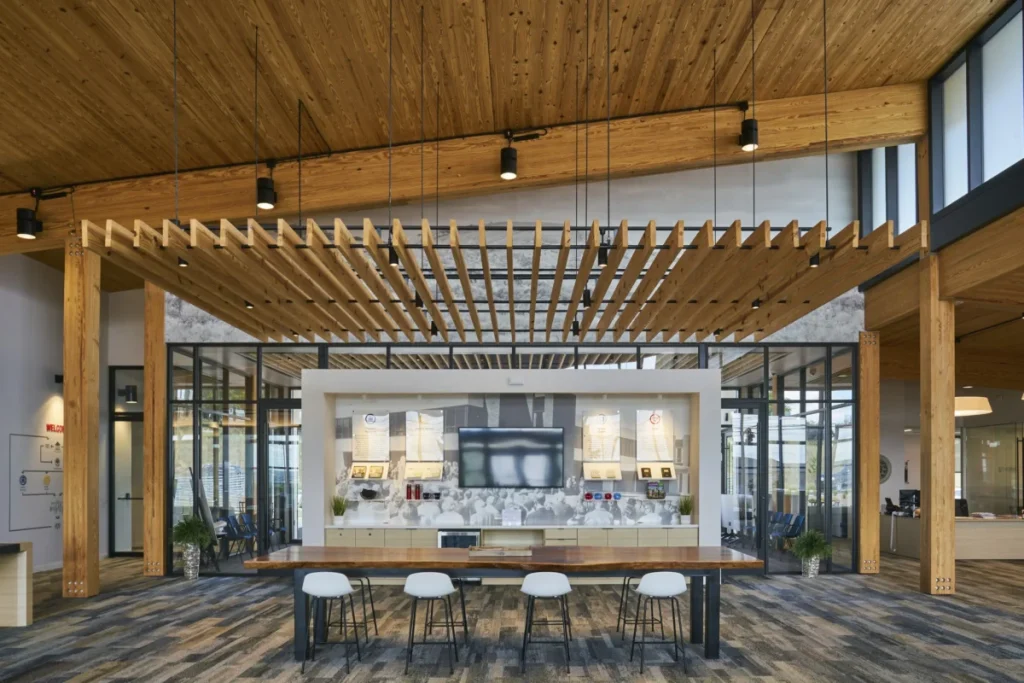
Companies like Crow Holdings, Toyota, Microsoft, and Walmart are embracing the natural material for productivity gains, sustainability, and the bottom line. It’s the stuff of employer dreams in a post-pandemic landscape: something that studies say can increase employee focus, reduce absenteeism, foster a productivity improvement of 8 percent, and generate anywhere from $2,000 to $6,000 per employee each year.
Those are some of the findings shared by Crow Holdings Managing Director Jim McCaffrey as he outlines the business case for mass timber buildings. “Even if the studies are half right,” he says, “that’s effectively a 20 percent rent offset.” In his view, that offers more upside than a grueling lease negotiation. “There are a lot of people that are out in the market who are saying, ‘Well, can I get $5 more in tenant improvements? How can I reduce the rent rate by two more dollars?’” McCaffrey says. “Why not put your people in a great place and let them thrive?” As employers leverage quality spaces to attract top talent, mass timber is gaining traction as a high-performance building material. A recent study from Partners Real Estate found the mass timber market is expected to surpass $1.5 billion by 2031. Texas is already benefitting from that growth. The state has more than 130 completed or active mass timber projects—one of the highest concentrations in the country.
The trend was the subject of a recent panel that included leaders from Microsoft, Walmart, Toyota, First United Bank, and Crow Holdings. Hosted by Gensler, the discussion was held in Frisco at The Offices at Southstone Yards, the largest mass timber office project in Texas. Developed by Crow Holdings, the 242,000-square-foot property was fully leased by Toyota Financial Services shortly after its completion in 2024. First United Bank has adopted a mass timber approach for multiple buildings across Texas—including the first such structure to feature southern pine CLT (cross-laminated timber). First United Bank also built a 40,000-square-foot mass timber regional HQ in Sherman. “What we’re doing with the interior and the exterior is bringing in better employees,” says CEO Greg Massey. “The side effect is we’re doing more business because we’re bringing in better employees, and better employees bring in better customers.”

Leaders at Walmart concur. In 2025, the retail giant moved employees from older buildings with limited window space to a new mass timber campus in Arkansas. Within nine months, the company was seeing job acceptances increase threefold. “Mass timber was a key decision early on,” says Christi Gallagher, Walmart’s director of corporate real estate and visitor experience. “[Creating a workplace that] reflects nature has been instrumental in helping us get talent that might not have otherwise considered us.”
For Toyota Financial Services, leasing the entirety of Southstone Yards appeared to be a strategic move—soon after, its parent company required full-time employees to return to the office four days a week. “We must tell employees what’s different this time—and this project is [central to that message],” says Tim Conlon, Toyota Financial’s real estate and workplace director.
Despite perceptions about higher costs for mass timber projects, McCaffrey argues that although mass timber may have a premium up-front cost, using the material can reduce long-term buildout costs. A view of First United Bank’s Sherman location.Photo by Stephen Walsh McCaffrey notes that tenant buildouts at Southstone Yards won’t require traditional costs like ceiling installations or column enclosures; those additions would cover the southern yellow pine that characterizes the building. For its part, Toyota isn’t seeing any major increase in its initial tenant improvement costs.
As it evolves, the mass timber trend is expanding to other asset types. Microsoft data center construction exec Andy Kirby says using CLT is part of the company’s goal to become carbon-negative by 2030. Unlike office users trying to captivate employees, the mass timber draw for Microsoft is less about aesthetics and more about sustainability—with data centers inhaling staggering amounts of power and water, opting for CLT balances the carbon scales. Gensler and Dallas’ Thornton Tomasetti partnered in 2024 to develop two hyperscale mass timber data centers in Virginia for Microsoft. Gensler estimates the projects will reduce the embodied carbon footprint by 35 percent compared to steel and 65 percent compared to concrete. Innovation is also unfolding closer to home—Dallas is the site of the first large-scale industrial facility constructed with CLT and MegaSlab tech in North America. Southfield Park 35 Building 4, completed in 2022, spans 160,475 square feet and is fully leased to a single tenant: Serta.

“The success of Building 4 signals that mass timber construction is not just a niche office trend but a viable, scalable solution for industrial and logistics spaces,” Partners Real Estate reports. “As developers and occupiers increasingly prioritize sustainability and operational efficiency, mass timber could become a key material in shaping the next generation of warehouses, distribution centers, and manufacturing facilities.” Meantime, Crow Holdings is full steam ahead. Following the success of The Offices at Southstone Yards, the developer is changing strategies for its building across the street from concrete to mass timber. McCaffrey says the company is getting interest from debt and equity parties; now that there’s proof of concept, a mass timber project seems less risky. “I’m excited,” he says. “There’s going to be much less wind in our face.”
Case Study: The Health Case for Timber
Biophilic design is driving corporate demand—and producing measurable benefits.
With more than 1,600 active projects nationwide, mass timber is gaining traction for reasons beyond aesthetics. Biophilic environments—spaces that incorporate natural materials—have been shown to reduce stress, lower blood pressure, and improve comfort. A Corgan study found that rooms with 45 percent wood surfaces delivered meaningful physiological benefits. Overall, biophilic design is reported to increase productivity by up to 15 percent and improve staff retention rates. Those metrics are among the drivers for projects like The Offices at Southstone Yards, a Crow Holdings development designed by Gensler. “Studies have reported a 23 percent lower stress level,” says Jim McCaffrey of Crow Holdings. “Can you imagine if we could create a pill that could lower your stress by 23 percent?”
https://www.dmagazine.com/