
From a substitute material to an industry ecosystem
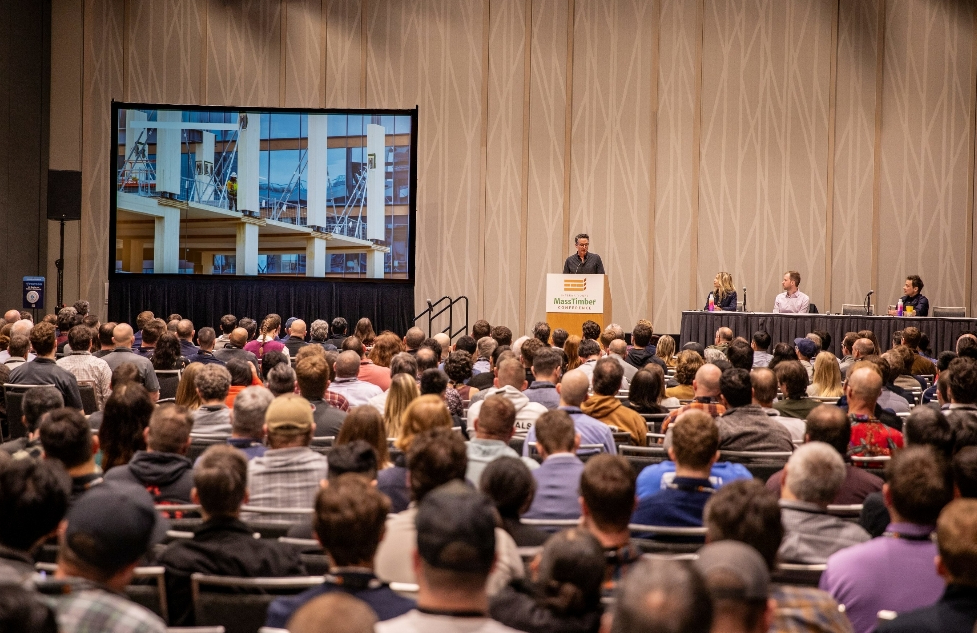
The International Mass Timber Conference 2026 (https://masstimberconference.com) – the world’s largest event dedicated to wood construction – is taking place in Portland, USA, bringing together thousands of experts, businesses, and investors across the entire value chain. This year’s conference reflects a clear shift: mass timber has moved beyond the experimental stage and is entering a phase of acceleration, where issues of scale, finance, and industry structure have become central to discussions. After more than a decade of development, structural wood is no longer viewed merely as an alternative material, but is increasingly positioned as a comprehensive solution capable of reshaping the entire construction value chain.
The atmosphere at this year’s conference makes one thing evident: structural wood has passed the testing phase and is now entering a period of rapid growth, where questions of technology are giving way to broader challenges related to scale, finance, and industry structure. Over the past decade, structural wood has gradually demonstrated its ability to partially replace concrete and steel in a wide range of building types. However, what makes the 2026 conference different is how the industry is redefining itself—not as a sustainable alternative, but as an integrated system with the potential to transform how construction is delivered.
Capital flows and the industrialization of construction
One of the clearest signs of this transition is the emergence of a dedicated investment networking space, where project developers meet directly with investors, banks, and financial institutions. In this setting, structural wood projects are presented directly to capital providers. These activities are not merely symbolic; they reflect a broader reality: the structural wood sector is entering a phase where capital flows and investment performance are becoming decisive factors.
The growing presence of investors also brings new requirements. Projects must not only be technically feasible but also demonstrate cost transparency, scalability, and repeatability in design and delivery. This, in turn, requires the entire ecosystem—from manufacturers and designers to contractors—to operate in a more standardized and coordinated manner.
Alongside capital flows, another strong movement is the industrialization of construction through structural wood. At the exhibition area, large-scale component manufacturing, multi-axis CNC processing, and prefabrication solutions are being showcased with increasing maturity. Instead of fragmented production, the industry is moving toward an integrated process linking digital design, off-site manufacturing, and on-site assembly.
This shift is fundamentally changing the nature of construction. Value creation is no longer concentrated on-site but is moving upstream to factories, where components are produced with higher precision and better time control. In this context, construction sites are gradually becoming assembly points rather than traditional building sites.
Supply chain constraints and growth drivers
However, this transition also exposes critical bottlenecks in the supply chain. Many discussions at the conference highlight that current production capacity has not kept pace with growing demand, particularly outside North America and Europe. The shortage of large-scale manufacturing facilities, combined with reliance on certified raw materials, is putting pressure on both costs and project timelines.
In response, the industry is adopting a more holistic approach to cost. Discussions are shifting away from material price comparisons toward life-cycle cost analysis, construction timelines, and operational efficiency. Many case studies demonstrate that by shortening construction time and reducing errors, structural wood can compete directly with traditional building methods, especially in projects that demand high quality and speed.
Another notable highlight is the participation of major technology companies in sessions showcasing real-world projects. Buildings constructed with structural wood in office campuses and research facilities indicate that the material is no longer experimental but has become part of long-term development strategies for leading corporations.
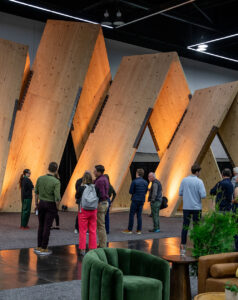
Beyond industrial and financial aspects, the conference also features architectural experimentation, where wood is explored as a medium of expression. Experimental structures with curved forms demonstrate the expanding possibilities of timber architecture beyond traditional geometric constraints.
All of these developments are taking place within a broader context: the increasing pressure to reduce carbon emissions in the global construction sector. With its carbon storage capacity and potential to replace high-emission materials, structural wood is being integrated into sustainability strategies and green building standards in many countries. This is not only a competitive advantage but also a key factor shaping the market in the long term.
For Vietnam, the developments observed in Portland raise important strategic questions. As structural wood enters a phase of large-scale expansion and becomes increasingly tied to global capital flows, participating in this value chain will require more than manufacturing capacity. It involves standards, ecosystem coordination, and positioning within a rapidly evolving global market.
At this point, structural wood is no longer a trend to observe from a distance. It is becoming part of the mainstream trajectory of the global construction industry. And like any major transformation, opportunities will not necessarily belong to those who move first, but to those who clearly understand the system they are entering.
This article is compiled from conference content, industry publications, and related official materials.