
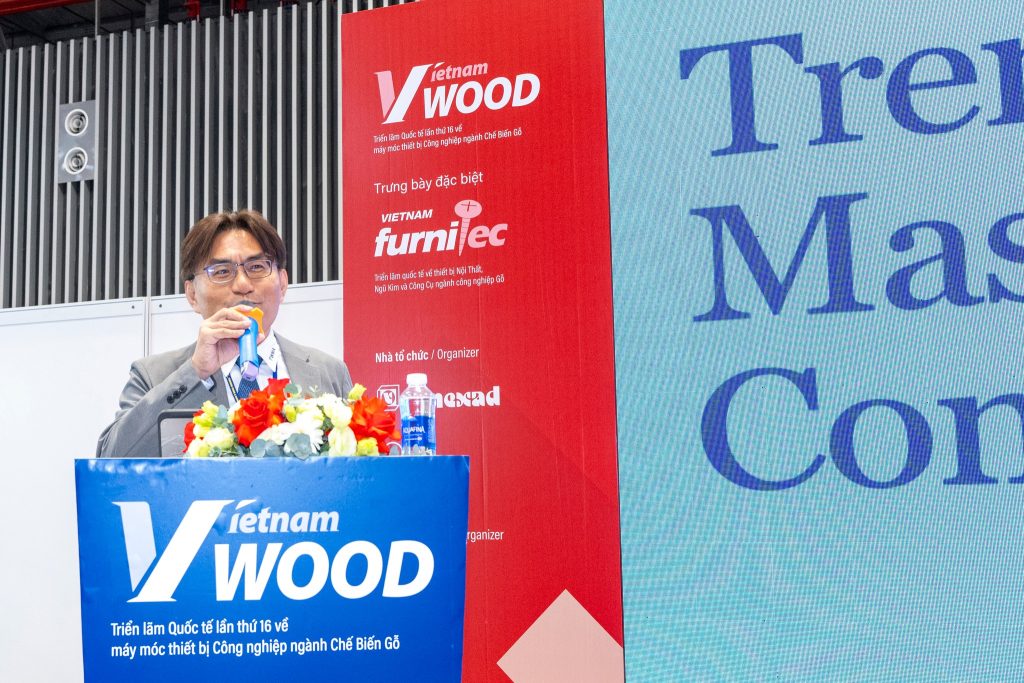
In discussions about high-rise timber architecture, much of the attention often focuses on CLT or on iconic timber buildings around the world. However, the presentation delivered by Mr. Cliff Chang, Director of SK Global Co. Ltd, at Vietnam Wood 2025 offered a different perspective: to understand how timber buildings can rise to many storeys, one must look at the manufacturing technologies behind structural wood—particularly glulam, one of the most critical load-bearing components of mass timber systems.
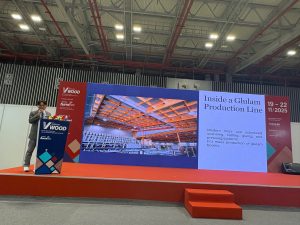
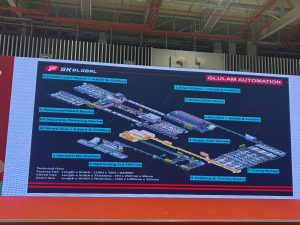
At the conference, Mr. Chang emphasized that the advancement of timber architecture does not begin at the construction site, but in the factory, where production is standardized and automated. Glulam, known for its superior ability to carry long spans, only performs at its full potential when each lamella is produced under strict quality control—through defect scanning, optimized cutting, finger-jointing, pressing, and finishing. Each stage relies on high-precision sensors and automated machinery, transforming engineered wood from a craft-based material into a consistent industrial structural component.
This perspective explains why multi-storey timber buildings in countries such as the United States, Norway, and Japan can be erected quickly, with minimal tolerance errors and high structural reliability. When materials are produced to industrial standards, architects can push design boundaries, engineers can predict structural performance with confidence, and contractors can install components using assembly-based construction methods. The feasibility of large timber structures, therefore, stems not only from sustainability ambitions but also from achieving the technical stability required to replace steel and concrete in many applications.
From this viewpoint, glulam is not merely a component—it’s a technical foundation for high-rise timber architecture. Tall timber buildings rely on beams, columns, and structural elements that integrate seamlessly into digital design models while meeting strict requirements for load-bearing capacity, fire performance, and seismic behavior. It is the manufacturing technology behind glulam—not just the material itself—that determines whether these structures can be realized.
Looking ahead, the glulam production lines showcased by SK Global are shaping the future mass timber ecosystem: a system in which materials are manufactured as precision components, designed and validated through data, and assembled with industrial efficiency. High-rise timber architecture, therefore, is not only a story of forests, carbon, or aesthetics, but the outcome of steady technological progress in the manufacturing of structural wood.