
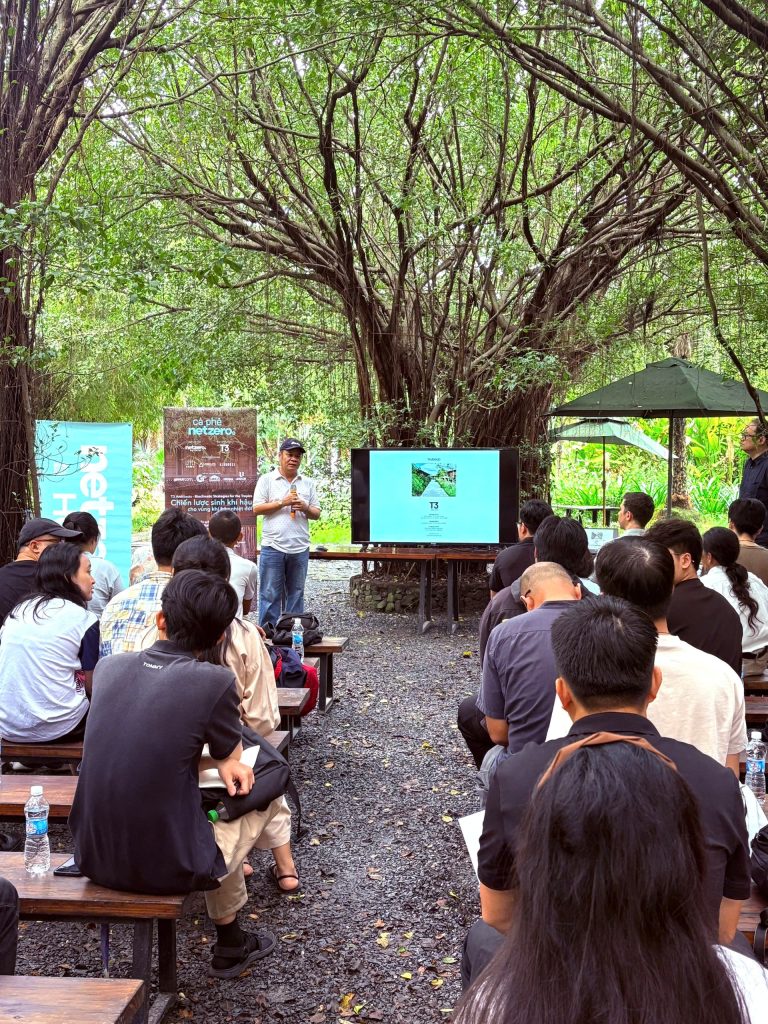
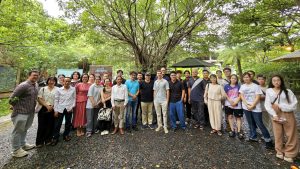
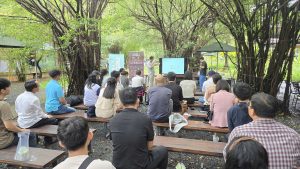
On the morning of September 14 in Ho Chi Minh City, Net Zero Coffee #23 took place under the theme “Bioclimatic Design Strategies for the Tropical Zone”. The event, held in a refreshing green setting, attracted nearly 50 participants, including architects, environmental experts, project developers, and businesses. It was organized by Net Zero Vietnam, with the sponsorship of the Association of Structure Architecture Wood – Ho Chi Minh City (SAWA) and other supporting partners.
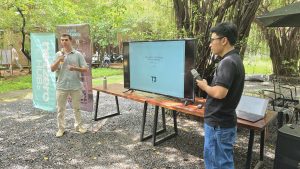
The keynote speaker was Architect Rafael Lira, Country Director of T3 Architects in Vietnam. Born and raised in Rio de Janeiro, Brazil, he graduated in Architecture & Urban Planning and holds a Master’s degree in Construction Management. Before moving to Vietnam in 2017, Rafael gained extensive experience in designing projects across tropical climates. Passionate about sustainable and bioclimatic architecture, he has become a strong advocate for environmentally responsible building solutions.
The design philosophy of both Architect Lira and T3 Architects is built upon four pillars: Harmony, Innovation & Health, Knowledge & Skills, and Creativity. Among these, the guiding principle of “doing more with less” serves as a constant direction. Rather than relying on energy-intensive technologies, T3 prioritizes smart planning and adaptive design solutions that allow buildings to respond naturally to their environment while reducing emissions from the very first stage of material selection.
Guided by this nature-based philosophy, T3 aims not only to create architecturally beautiful projects but also to ensure climate adaptability, energy efficiency, and minimal environmental impact. From master planning, natural ventilation, and daylight optimization to the use of sustainable materials and circular economy models, every solution presented by T3 shared the same goal: to build structures that exist in harmony with nature and serve people and communities sustainably.
The real-world examples introduced by Rafael Lira resonated strongly with the audience, illustrating a practical pathway amid rapid urbanization and mounting climate pressures. Projects that incorporate bamboo, wood, rammed earth, or natural stone demonstrate not only significant carbon reduction but also cultural identity and a sense of human connection. This is an architectural approach rooted in humanism—where people and the environment complement and enrich one another.
In his remarks, Mr. Võ Quang Hà – Chairman of SAWA – emphasized that the sustainable development of wood in construction is the industry’s long-term direction. He noted that many of the design principles presented by T3 align with SAWA’s vision: positioning wood at the core of green architecture, recognizing it as a material that is both environmentally friendly and a viable substitute for high-emission materials. According to him, the integration of bioclimatic design and wood-based construction, if scaled up, could bring tangible contributions to emission reduction and the improvement of building quality in Vietnam.
The event further underscored SAWA’s role in accompanying the architectural and construction community to advance sustainability values. Beyond its focus on members, SAWA is committed to fostering international connections and promoting wood as a mainstream choice in modern construction, particularly in rapidly growing urban areas.
With these contributions, Net Zero Coffee #23 was more than just a professional discussion. It stood as a testament to the spirit of collaboration toward sustainable development. The event highlighted the convergence of international architectural knowledge and Vietnam’s local context, opening the way for green solutions to be applied more concretely and effectively in daily life. And along this journey, wood—traditional yet ever-evolving—continues to assert its central role in contemporary architecture.