

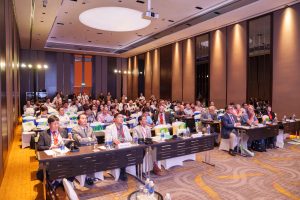
HCM City – On November 18, 2025, at the Sheraton Hotel, the Softwood Export Council (SEC), led by President Rose Braden, hosted the 2025 U.S. Softwood Seminar. The event gathered a large number of architects, engineers, project developers, and wood manufacturers and suppliers from both countries. Beyond introducing the advantages of U.S. softwood, the seminar opened a broader conversation: Vietnam is entering a pivotal phase in embracing the next era of modern wood construction.


The program featured presentations, product showcases, and expert discussions from SEC, U.S. enterprises, HAWA, universities, and wood industry associations. To align with SAWA’s development direction for structural wood, this article highlights four sessions most relevant to the field of structural wood, modern wood construction, and SAWA’s ongoing initiatives. These include presentations by Architect Scott Barton-Smith, Mr. Nguyễn Mạnh Bình San (Vice President of SAWA), Mr. Nguyễn Phương (Vice President of SAWA), and remarks by Mr. Võ Quang Hà, Chairman of SAWA, during the open panel on architecture and wood construction. Together, their insights offer a clear reflection of the latest technical trends, practical applications, and development perspectives for structural wood in Vietnam — a strategic priority SAWA is actively pursuing.
WOOD – A MATERIAL OF HUMANITY AND EMOTION
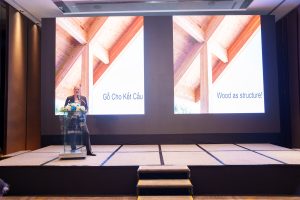
In the opening session, Architect Scott Barton-Smith provided a deeply human perspective on wood, describing not its technical attributes but the way people respond emotionally when entering a wooden space. He argued that our instinctive comfort with wood does not come merely from aesthetics but from a primal connection. Humans are born into nature, grow up around trees, and therefore find wooden environments naturally calming and safe. Scott referenced several international studies showing measurable effects: children’s heart rates drop in wooden classrooms, concentration improves in workplaces incorporating natural materials, and creativity increases in environments that feel less industrial. These findings highlight the direct influence wood has on the brain and emotional well-being.

He emphasized that designing with wood means creating humane spaces. A wooden library encourages people to linger; a wooden school reduces stress and helps students focus; a wooden office provides a sense of care that motivates employees. Through examples from the United States, including the Holgate Library and several community centers in Oregon, Scott conveyed a clear message: wood is more than a material choice; it is a choice that enhances quality of life. In increasingly dense and stressful urban environments, reintroducing wood into modern spaces allows architecture to reconnect with human emotion and natural instinct.
MASS TIMBER – REDEFINING WOOD FOR MODERN CONSTRUCTION
Scott also discussed the rise of Mass Timber, emphasizing its capacity to transform small pieces of wood into high-performance structural components. Engineered wood products such as Glulam, CLT, MPP, and DLT are not merely multilayered panels but restructured systems designed to function as beams, columns, and floors for multi-story buildings. Addressing the common concern about fire safety, he explained that wood burns in a predictable pattern, forming a protective char layer that preserves the structural core. In contrast to steel, which loses strength rapidly at high temperatures, Mass Timber maintains structural integrity for a significantly longer period. This is why some U.S. projects use wood to protect steel rather than relying on steel to protect wood.


Scott highlighted the economic and structural advantages brought by the material’s lightweight nature, which reduces foundation loads and seismic demands. In earthquake-prone regions like Oregon, timber buildings often require fewer complex systems, saving substantial costs. In dense cities such as Ho Chi Minh City, the speed, cleanliness, and low disruption of Mass Timber construction present clear advantages. One example he cited was a 150,000-square-foot project erected in just 12 weeks by a team of seven workers, with CNC-prefabricated components assembled on-site like a large-scale kit. For countries prioritizing rapid, clean, and efficient construction, Mass Timber offers a compelling path forward.
WOOD IN HOT AND HUMID CLIMATES – FROM CONCERN TO OPPORTUNITY
Scott addressed the question most relevant to Vietnam: the suitability of wood in a hot and humid climate. He emphasized that many concerns about wood stem from misconceptions rather than material limitations. Wood naturally absorbs and releases moisture through microscopic capillaries, but deterioration occurs only when the material is exposed to liquid water over long periods — a condition that proper design readily prevents. He explained the differences between fully exposed, semi-exposed, and fully protected applications, noting that semi-exposed conditions often cause misunderstanding within the industry despite being manageable through good design.
He outlined internationally accepted techniques such as post-production treatment, elevating structures to avoid moisture accumulation, ensuring proper water drainage, maintaining ventilation, and selecting appropriate connection details. Scott referenced projects from the Pacific Northwest — a region known for high rainfall and humidity — including Tillamook Creamery and Cedar Speedster, which have performed reliably over time. He concluded that climatic challenges should be viewed as opportunities for Vietnam to position wood as a high-tech material. Many international academic institutions and developers intentionally choose wood to demonstrate environmental commitment, prioritize human health, and establish distinctive architectural identities. These global trends suggest that Vietnam can leverage wood to align with sustainability goals and urban development needs.
INSIGHTS FROM A DECADE OF VIETNAMESE EXPERIMENTATION

Complementing Scott’s global perspective, Mr. Nguyễn Mạnh Bình San presented findings from nearly ten years of experimenting with wood in Vietnam’s hot and humid climate. His team at Newhouse Solution conducted extensive trials ranging from natural softwood beams spanning 11 meters to modular wooden units for prefabricated structures and large LVL components for wider spans. One notable experiment involved loading 40 tons onto a roof constructed from softwood beams, with some beams meeting the load requirements and others failing. He shared the results transparently and concluded that softwood can be effective for spans under six meters when using the correct grade, proper treatment and appropriate steel reinforcement at connection points.

Mr. San emphasized that SAWA and Newhouse are jointly developing a comprehensive ecosystem of architects, contractors, suppliers, and material developers, anchored by the Mass Timber Exhibition. The exhibition will feature eight prototype structures designed to represent eight different capabilities of large-scale timber, allowing the Vietnamese construction community to interact directly with real-world applications of Mass Timber.
A MANUFACTURER’S VIEW: VITANA’S TWO DECADES WITH SOFTWOOD

Mr. Nguyễn Phương, Chairman of Vitana and Vice President of SAWA, offered a manufacturer’s perspective shaped by more than twenty years of working with softwood in Vietnam. Vitana specializes in components, door frames, and laminated panels exported to the United States, with Radiata Pine and Southern Yellow Pine (SYP) serving as its primary materials. Radiata Pine has long been the company’s backbone due to its stability, ease of processing, and superior finishing quality — characteristics highly valued by U.S. customers.

In recent years, Vitana has explored transitioning a larger share of its production to Southern Yellow Pine, aiming to capitalize on its strength and attractive grain. Early results have been encouraging, particularly in interior and millwork products. However, Mr. Phương acknowledged several challenges, including commercial dimensions that are not yet optimal for production, occasional inconsistencies in supply, higher processing requirements due to wood density, and natural resin content that affects bonding and finishing. He affirmed that softwood will continue to play a critical role in Vietnam’s manufacturing sector and that deeper collaboration between Vietnamese enterprises and U.S. suppliers can improve both material quality and long-term industry competitiveness.
OPEN DIALOGUE: A GOLDEN OPPORTUNITY FOR VIETNAM’S WOOD CONSTRUCTION SECTOR

During the open dialogue session, Mr. Võ Quang Hà — Chairman of SAWA and Chairman of TAVICO — emphasized that Vietnam’s construction market is entering a stage where new materials must meet multiple criteria simultaneously: lightweight performance, sustainability, rapid installation, and compliance with international certifications. U.S. softwood, with its stable supply and FSC/PEFC certifications, presents a viable option for housing, commercial buildings, and community spaces.
Mr. Hà highlighted the natural benefits of wood, such as user comfort, aesthetic value, and ease of processing. He stressed that durability in tropical climates depends on proper understanding of material behavior — from choosing the right species and treatment method to ensuring shading, ventilation, and appropriate detailing. He linked these insights to Vietnam’s national commitment to Net Zero 2050, noting that structural wood can meaningfully contribute to emission reduction goals. Plantation wood can be engineered into large structural components such as CLT, Glulam, and LVL, suitable for factories, exhibition centers, and multi-story buildings.
He also pointed out that the absence of a national Mass Timber standard remains a significant barrier for investors. Therefore, SAWA’s collaboration with SEC and international experts — through standard development, demonstration projects, and the establishment of a Structural Wood Showroom at TAVICO — will play a pivotal role in building confidence across the market. He concluded by encouraging young architects to cultivate a deep appreciation for wood and pursue continuous learning, experimentation, and innovation, believing they will be the driving force shaping Vietnam’s wood construction landscape in the coming decade.
A New Chapter for Wood Construction in Vietnam

The U.S. Softwood Seminar 18.11.2025 served not only as a material showcase but also as a milestone marking a significant shift for Vietnam’s construction industry. Through insights from international experts, lessons from domestic experimentation, and perspectives from industry leadership, a clear picture emerged: softwood and Mass Timber will play an essential role in Vietnam’s development of modern, sustainable construction. SAWA believes that with continued international cooperation, stronger local research, and accelerated standardization, Vietnam can position itself as a regional leader in green wood construction within the next decade.