
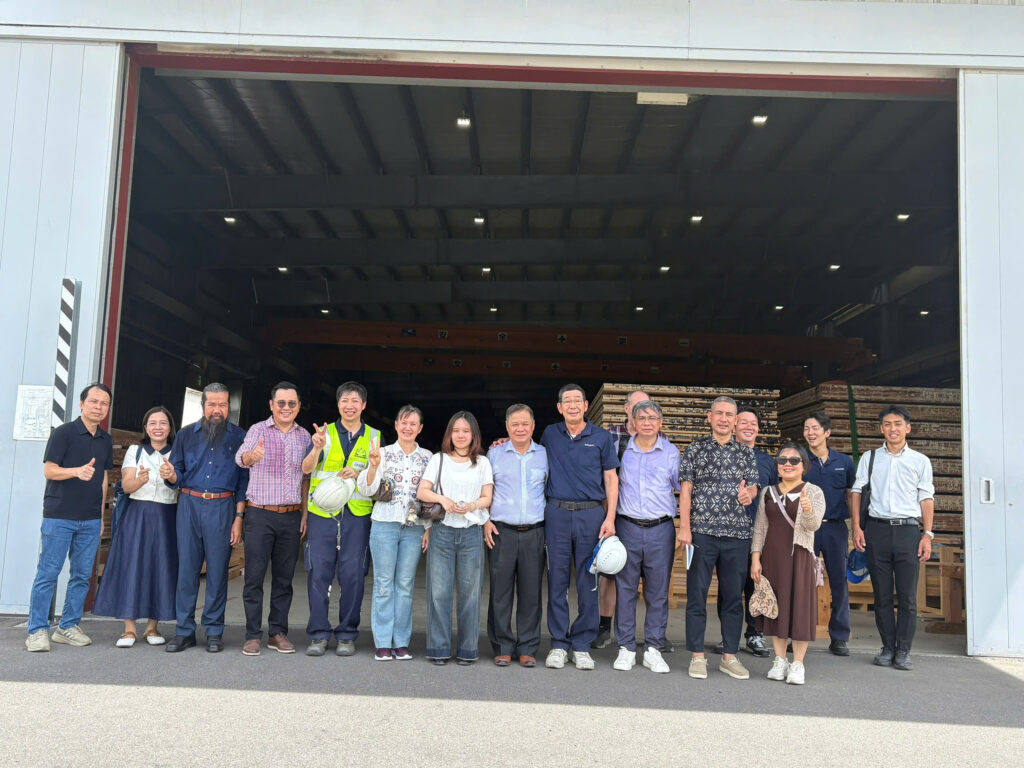
On August 28, 2026, the final day of the SAWA Go To Japan 2026 journey in Japan, the delegation visited and worked with SUNADAYA’s Glulam Structural Timber Manufacturing Facility in Ehime Prefecture, one of Japan’s leading large-scale structural timber production facilities. The delegation was personally welcomed by Mr. Yutaro Sunada, Chairman of SUNADAYA, who introduced the company and personally led the delegation through its production system. The scale of the facility, its high production capacity, integrated production lines, and advanced processing technologies made a strong impression on the delegation.
Large-Scale Production, Advanced Technology, and an Integrated Process from Logs to Glulam and CLT
SUNADAYA has developed a large-scale engineered timber manufacturing model in which the processes from logs and sawn timber to drying, Glulam, and CLT are organized within an integrated production system. According to information presented at the facility, its production capacity is approximately 600 m³ per shift, operating two shifts per day, equivalent to around 300,000 m³ per year. The plant occupies approximately 6.6 hectares and is equipped with 22 drying kilns powered by biomass heat. Around 90% of the thermal energy required for the drying process is generated from wood by-products. The scale and organization of this production system were among the factors that left a particularly strong impression on the delegation. The plant’s primary raw materials are Hinoki, accounting for approximately 80%, and Sugi, approximately 20%, with around 95% sourced from domestic Japanese timber. The use of predominantly domestic timber creates a direct connection between the manufacturing facility and Japan’s forest resources, while also allowing more value to be added to locally sourced timber within the domestic production chain.
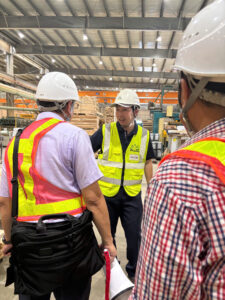
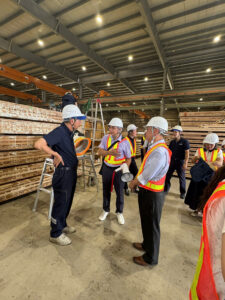
According to information from Obayashi Corporation, SUNADAYA is one of the few companies in Japan equipped with large-scale facilities capable of carrying out an integrated production process from logs through to finished products. IT technology is applied throughout the processing stages, from sawing and machining to finishing, helping to control product accuracy and consistency. For Glulam – glued laminated timber, the technology enables selected and processed pieces of timber to be bonded together into larger and more dimensionally stable structural members capable of meeting higher structural requirements. This is one of the important areas of development in Japan’s engineered timber industry, expanding the range of applications for timber in modern construction.
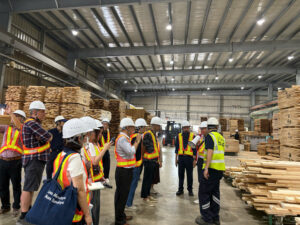
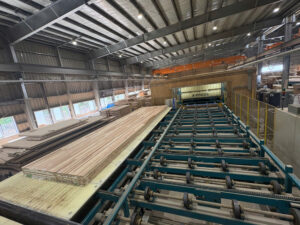
For CLT – Cross-Laminated Timber, SUNADAYA’s production capability is particularly notable. The facility is equipped to manufacture CLT panels measuring up to 3 meters wide and 12 meters long, among the largest panel dimensions produced in Japan. Large-format CLT panels can be used for various parts of buildings, including floors, walls, and structural components, thereby expanding the potential application of timber in large-scale construction. This production capability has already been demonstrated in major projects. Approximately 1,800 m³ of CLT manufactured from Sugi and Hinoki sourced from the Shikoku region was used for the flooring of the Grand Ring, the landmark structure of Expo 2025 Osaka-Kansai. The project provides a clear example of SUNADAYA’s ability to manufacture large volumes of engineered timber products and supply Shikoku-grown timber for a major international-scale architectural project.
SUNADAYA also has a predominantly domestic market. Approximately 90% of the plant’s production is consumed within Japan, reflecting the significant demand for structural timber products and the development of the timber construction market in the country.
From Timber Industry Policy to Decarbonization
The development of SUNADAYA has taken place within a broader context of Japanese policies aimed at increasing the value of domestic timber resources and promoting the use of wood in construction. During the investment and expansion of the plant in 2016–2017, the SUNADAYA project involved total investment of approximately ¥7.71 billion, including approximately ¥3.273 billion in government support under timber industry development programs. These support programs focused on strengthening timber processing capacity, developing engineered wood products such as Glulam and CLT, and creating additional demand for timber in the construction sector. This was also a period when Japan was accelerating the development of technologies, standards, and markets for CLT, viewing the material as an important way to expand the use of timber in buildings with greater scale and higher technical requirements.
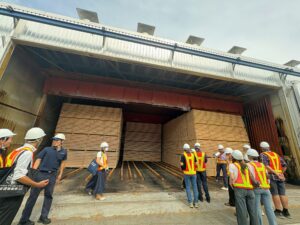
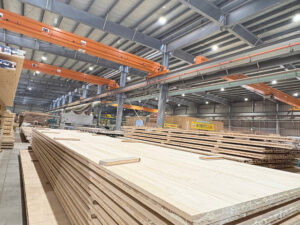
In Ehime Prefecture, the development of CLT was also identified as an important avenue for creating new demand for locally sourced timber, expanding markets for timber products, and increasing the value of the forestry industry. The establishment and expansion of facilities such as SUNADAYA therefore formed part of a broader direction: transforming local timber resources into higher-value products while creating stable markets for the domestic timber industry. Japan’s policies promoting the use of timber in construction have continued to expand in recent years and have become increasingly connected with the goal of achieving a decarbonized society. In 2021, Japan revised its legal framework for promoting the use of wood in buildings, expanding its scope beyond public buildings to include private-sector construction. The use of timber has increasingly been considered in connection with forest management, renewable resources, increased utilization of domestic timber, and emissions reduction.
At SUNADAYA, this focus on energy efficiency and emissions reduction is also reflected in the use of biomass and solar power. Since 2025, the facility has operated a rooftop solar power system with a capacity of approximately 2 MW, expected to reduce CO₂ emissions by approximately 970 tonnes per year. The development of SUNADAYA can therefore be viewed through several interconnected layers: domestic timber resources, processing technology, Glulam and CLT manufacturing, industrial-scale production, the construction market, and policies promoting the use of timber. Sugi and Hinoki are transformed into large-format engineered timber products; wood by-products are converted into thermal energy for drying; and solar power provides an additional source of renewable electricity for the manufacturing operation.
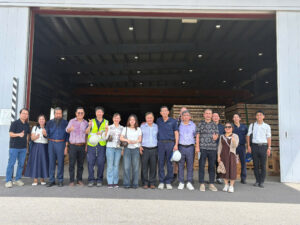
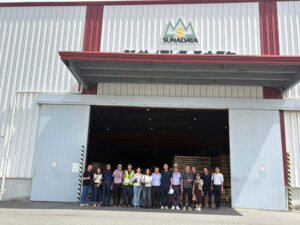
The final-day visit gave the delegation a clear view of the scale and level of development of Japan’s structural timber industry, where Glulam and CLT are no longer simply emerging materials, but are manufactured at industrial scale and used in major construction projects.
From a Sugi or Hinoki tree in the forest to CLT panels measuring 3 meters by 12 meters and large Glulam structural members, SUNADAYA demonstrates how technology and industrialization are significantly expanding the possibilities of a material that has been deeply rooted in Japanese architecture for centuries.