
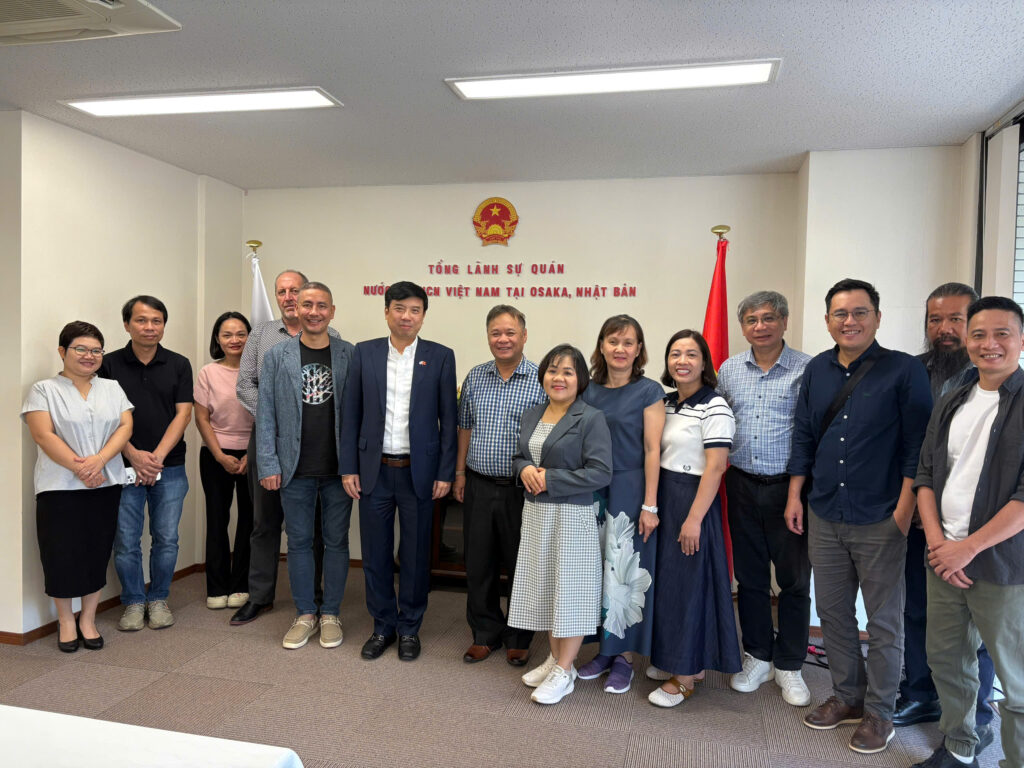
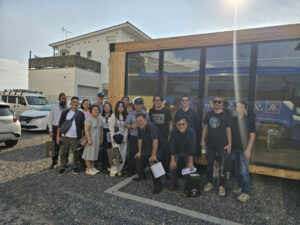
On the first day of SAWA Go To Japan 2026 (24 August 2026), a delegation of 13 members, including SAWA leadership and representatives from 10 companies across Vietnam’s wood construction value chain, began its study and business networking journey in Japan. Representing key segments of the industry — from timber production, processing and machining to materials, structural systems, design and construction — the delegation is exploring Japan’s development models, structural and prefabrication technologies, and opportunities for deeper business cooperation. The delegation is led by Mr. Vo Quang Ha, Chairman of the Ho Chi Minh City Association of Construction Wood (SAWA).
📍 VISIT TO THE CONSULATE GENERAL OF VIETNAM IN OSAKA


The delegation visited the Consulate General of Vietnam in Osaka and had the honor of being welcomed by Mr. Nguyen Truong Son, Consul General of Vietnam in Osaka. Osaka has long been an important commercial and industrial hub, with a well-developed ecosystem of timber-related businesses spanning trading, processing, machining and distribution. The wider Osaka–Kansai region also offers a diverse network of companies and organizations across the wood value chain. In this context, the Consulate General of Vietnam in Osaka serves as an important bridge for Vietnamese businesses seeking to connect with local companies, organizations and potential partners.
📍 NARA – PRESERVING THE ESSENCE OF JAPANESE WOODEN ARCHITECTURE

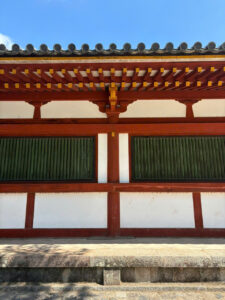
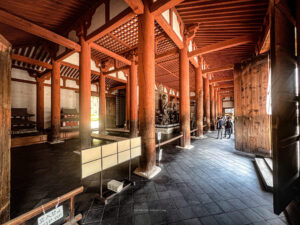

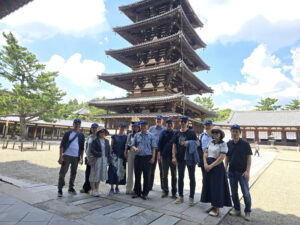
The delegation then continued to Nara, home to some of Japan’s oldest wooden architectural heritage, reflecting centuries of evolution in timber construction techniques. At Horyuji Temple (法隆寺), a UNESCO World Heritage Site, the delegation had the opportunity to observe wooden structures that have stood for more than 1,300 years. From the perspective of structural timber engineering, Horyuji offers remarkable insight into how columns, beams, traditional timber joinery and multi-tiered bracket systems work together as an integrated load-bearing system. Loads are transferred from the roof through the bracket assemblies to the columns, while the architectural form remains closely connected to the structural logic and natural properties of timber. It is a remarkable example of the rational structural thinking embedded in traditional Japanese timber architecture.
📍 KITANO MOKUZAI CO., LTD. – WOOP
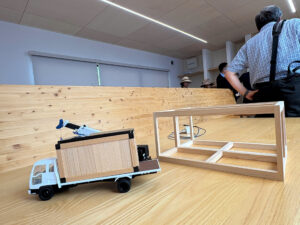
At Kitano Mokuzai Co., Ltd., a company with nearly a century of experience in the timber industry, the delegation explored WOOP, a modular wooden housing system developed around a rigid timber-frame structure.
A key feature of WOOP is its structural system and column-base timber jointing solution. Precisely machined frame components are connected at critical column-base nodes to establish a consistent load path within each module. The structural components are prefabricated in the factory, allowing greater control over dimensional accuracy and joint quality before they reach the construction site. With modules designed for lifting, transportation and on-site assembly, WOOP demonstrates how traditional timber craftsmanship can evolve into industrialized structural timber construction and modular building systems.


FROM HERITAGE TO INDUSTRIALIZATION
The first day of SAWA Go To Japan 2026 brought the delegation through three distinct layers of Japan’s wood ecosystem: business and institutional connectivity in Osaka, more than 1,300 years of structural timber heritage in Nara, and modern structural prefabrication at Kitano Mokuzai. It was a day of learning and observation — revealing how traditional timber knowledge continues to evolve into the precision, prefabrication and industrialized construction systems shaping the future of timber building.