
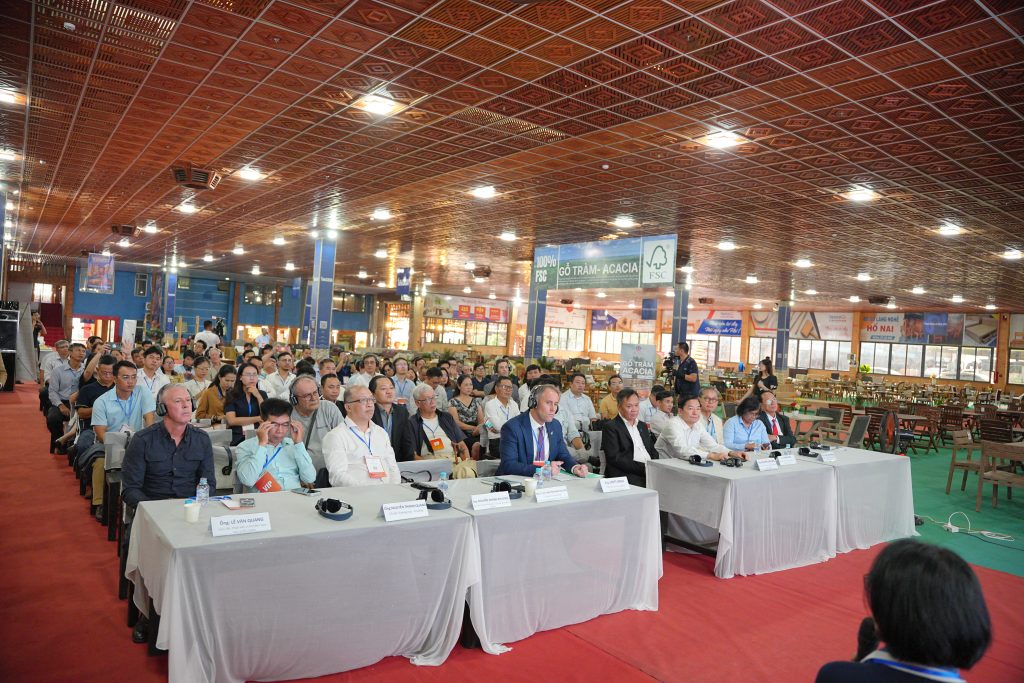
On the afternoon of 12 December 2025, within the framework of TAVICO HOME – VIEFURN 365, the Hội Gỗ Xây Dựng Thành phố Hồ Chí Minh (SAWA) organised the seminar “Wood Construction Vietnam – Building the Future” at TAVICO Home (Dong Nai Province).
The event welcomed 150 delegates representing government agencies, industry associations, technical experts, architects, and the business community.
The seminar took place at a time when Vietnam’s construction sector is facing increasing pressure to transition towards low-emission and sustainable development, while simultaneously meeting ever-higher international requirements related to legality, certification, and material traceability.
In this context, structural wood (mass timber) is increasingly recognised as a promising pathway. However, its adoption also raises critical questions regarding raw material supply, technical standards, and real-world applicability within Vietnam’s construction environment.
Wood in Vietnamese Architecture: A Conceptual Foundation for Modern Applications
Opening the seminar, Assoc. Prof. Dr. Architect Nguyen Hanh Nguyen – Head of the Founding Advisory Board, Landscape Architecture & Art Innovation Institute (LAAi) – delivered the presentation “Back to the Future – Vietnamese Wood Heritage in Contemporary Architecture.” The presentation reframed the way wood is perceived in Vietnamese architecture, emphasising that wood is not a new material, but one that has demonstrated long-term adaptability to climate, culture, and construction techniques. Drawing from Vietnam’s architectural wood heritage, the presentation offered insights into how wood can be reinterpreted in contemporary design, challenging common misconceptions related to durability, safety, and aesthetics.
International Experience: Sustainable Forestry and Low-Carbon Construction
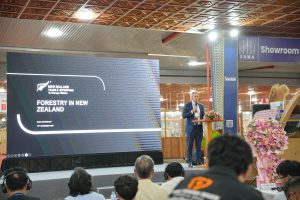
Mr. Scott James – Consul General of New Zealand in Ho Chi Minh City shared an overview of New Zealand’s plantation forestry sector, its FSC forest certification system, and global trends in the application of engineered wood and mass timber in low-carbon construction. According to the Consul General, New Zealand’s well-developed plantation forests and transparent forest management systems provide a strong foundation for wood to be used in high-requirement sectors such as construction. The use of wood in buildings is no longer driven solely by tradition or aesthetics, but by its carbon storage capacity, emission reduction potential, and ability to replace materials with high carbon intensity. These experiences offer valuable lessons for Vietnam in linking wood construction with legal, certified, and sustainable raw material sources.
Wood in the Net Zero and Sustainable Economy Framework
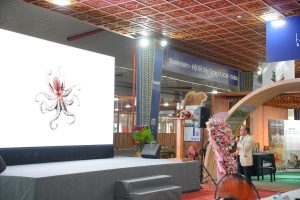
From an economic and sustainability perspective, Mr. Tim Nguyen – Director of the Sustainable Development Centre, Vietnam Digital Economy Institute presented “Integrating Wood into the Net Zero Economy – NetZeroNomy.” The presentation analysed the role of wood in reducing greenhouse gas emissions, storing carbon throughout the building life cycle, and integrating with green economy, circular economy, and digital economy models. In this framework, wood is positioned as part of a broader ecosystem, rather than being viewed merely as an isolated construction material.
Regenerative Architecture: From Strategy to Living Spaces
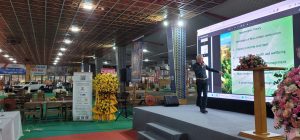
The session continued with Architect Lee Knowles – Interior Development Manager, Huni Architectes, who delivered the presentation “Structural Wood (Mass Timber) in Regenerative Architecture.” The presentation focused on the role of design in translating requirements related to plantation forestry, certification, Net Zero goals, and technical standards into real buildings and living environments. Structural wood was presented as a key tool of regenerative architecture—not only aiming to “do less harm,” but to create positive impacts on the environment, communities, and quality of life.
Panel Discussion: Connecting Policy – Expertise – Practice

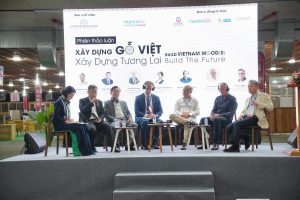
The open panel discussion and Q&A session featured the speakers together with Mr. Nguyen Van Dien – Deputy Director General, Department of Forestry and Forest Protection, and Mr. Nguyen Chanh Phuong – Vice Chairman, Handicraft & Wood Industry Association of Ho Chi Minh City (HAWA).
The session was moderated by Assoc. Prof. Dr. Architect Nguyen Hanh Nguyen.
Discussions centred on key barriers to the development of wood construction in Vietnam, including large-diameter plantation forests, sustainability certification, EUDR traceability requirements, technical standards, and market readiness.
The dialogue highlighted that advancing wood construction cannot be driven by a single stakeholder group, but requires close coordination between government authorities, industry associations, technical experts, and businesses.
Through the seminar “Wood Construction Vietnam – Building the Future,” SAWA aims to foster a shared understanding and common dialogue platform for the industry. This will serve as a foundation for future steps in developing structural wood construction in Vietnam, aligned with sustainable plantation forestry, international legal requirements, and long-term Net Zero objectives.