
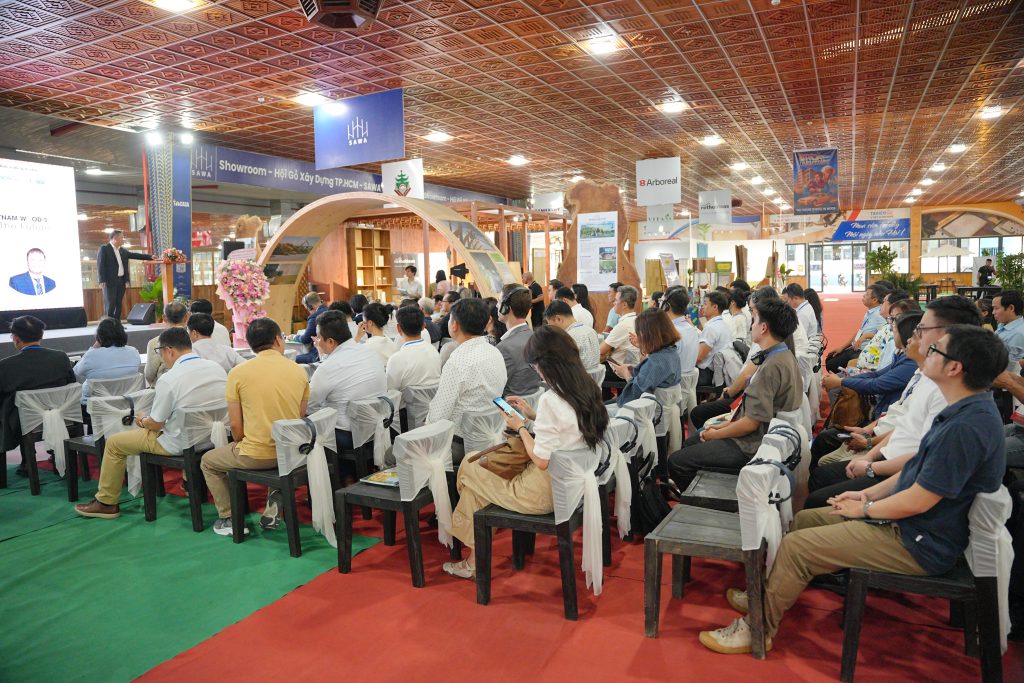
As domestic raw material supply remains limited, large-diameter plantation forests develop slowly, and regulations such as the EU Deforestation Regulation (EUDR) tighten requirements, the traditional growth advantages of Vietnam’s wood industry are facing significant challenges.
Raw Material Shortages
Information shared at the seminar “Wood Construction Vietnam – Building the Future,” organised by the Hội Gỗ Xây Dựng Thành phố Hồ Chí Minh (SAWA) on 12 December in Dong Nai, highlighted that the wood industry not only makes a substantial contribution to export turnover but also provides livelihoods for millions of workers across plantation forestry, harvesting, processing, and related services.
Vietnam’s wood and forestry product exports reached USD 17.34 billion in 2024 and are estimated to exceed USD 18 billion in 2025, with an average annual growth rate of over 10%.
However, the sector’s growth continues to rely heavily on cost advantages, contract manufacturing, and external raw material sources. A large proportion of wood used for export processing is still imported, leaving enterprises vulnerable to global market fluctuations—particularly as raw material prices, transportation, and logistics costs continue to rise.
According to Nguyễn Văn Diện, Deputy Director General of the Department of Forestry and Forest Protection, Vietnam’s key export markets—including the United States, the European Union, Japan, South Korea, and China, which together account for more than 90% of total wood export value—are imposing increasingly stringent requirements on legality, traceability, and environmental sustainability.
As a result, many wood-processing enterprises are seeking to shift back towards domestic timber sources, particularly certified wood from sustainably managed forests. However, domestic supply has yet to keep pace with the needs of large-scale export-oriented processing. Failure to address this bottleneck will place growing pressure on the entire wood value chain.
Large-Diameter Plantation Forests: Not Yet a Strategic Priority

Vietnam’s current plantation forestry landscape reveals a significant gap between sustainable development objectives and actual raw material supply capacity.
Mr. Dien noted that the development of large-diameter plantation forests and certified sustainable forests faces multiple challenges. Long production cycles—often exceeding ten years—entail high levels of risk. In addition, forestland remains fragmented among smallholder households, while forestry infrastructure is underdeveloped, resulting in high harvesting and transportation costs.
Another constraint is limited economic incentive. At times, price differentials between certified and non-certified timber have been minimal, making it difficult for forest owners to justify long-term investment.
Linkages along the value chain also remain weak. Few processing enterprises have actively engaged in partnerships with forest owners to co-invest in large-diameter plantations, certified forests, or long-term offtake arrangements.
From an economic perspective, Tim Nguyễn, Founder of NetZeroNomy, observed that many enterprises continue to remain detached from upstream forestry activities, focusing solely on processing and short-term raw material procurement. This leaves them highly exposed when markets fluctuate or when legal and traceability requirements evolve.
He emphasised that large-diameter plantation forests should be viewed as a strategic asset, directly linked to enterprise competitiveness. Only when businesses engage in forest investment, share risks and benefits with forest owners, can domestic raw material supply develop in a stable and sustainable manner.
EUDR Tightens Requirements: Enterprises Must Adapt
The European Union’s EUDR introduces stringent traceability requirements, under which each wood product exported to the EU must demonstrate legal origin, full transparency, and confirmation that it does not originate from deforested or degraded land, as defined by EU criteria.
This compels enterprises to invest heavily in supply chain management systems, digital traceability, and detailed data on timber origin—particularly geolocation data for forest plots.
In the long term, however, Mr. Dien believes that compliance with EUDR will strengthen the international positioning of Vietnamese wood products. The forestry sector will move closer to sustainable development goals, enhance value-added, and expand its presence in the EU—a demanding yet highly potential market.
Mr. Tim Nguyen added that when markets require traceability down to individual forest plots, enterprises can no longer focus solely on purchase prices. Instead, they must prioritise supply chain governance and long-term investment in legal raw material sources.
In response, businesses need to shift from merely buying raw materials to investing in raw materials, recognising sustainable plantation forestry as an integral component of long-term development strategies.