

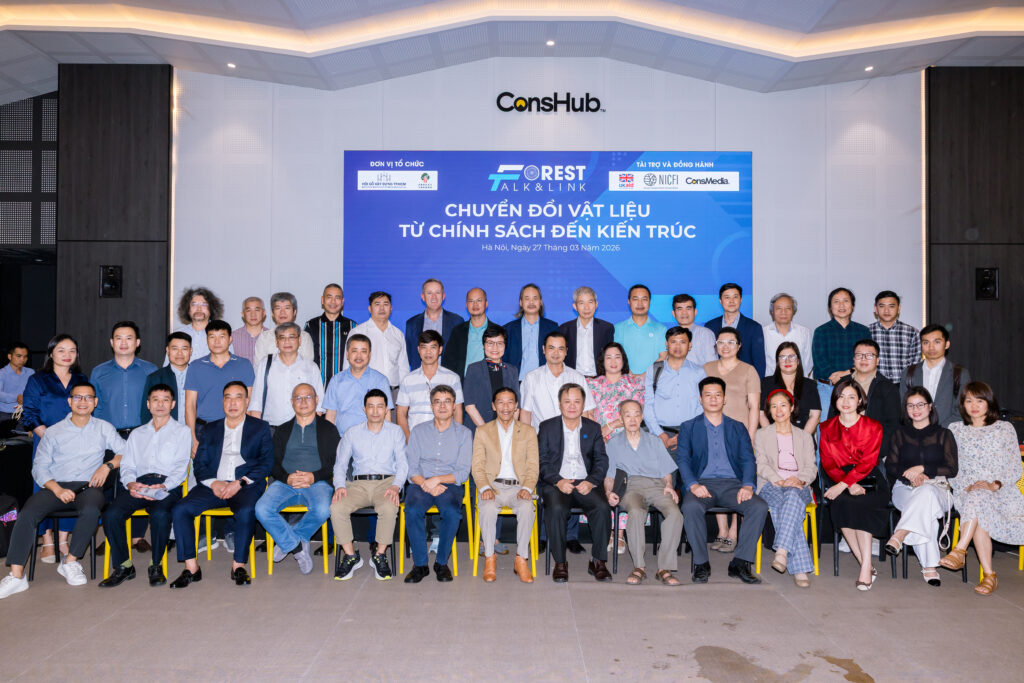
The tightening of global environmental standards is creating significant room for green materials. Among them, plantation timber and engineered wood are emerging as highly promising options for sustainable construction.
Expanding market opportunities from “green rules”
Material transition is no longer optional—it is becoming a mandatory requirement as major markets, especially the EU, continue to tighten environmental standards. At the Forest Talk & Link #2 program titled “Material Transition – From Policy to Architecture”, organized by the Ho Chi Minh City Structural Wood Association (SAWA) with technical support from Forest Trends and in collaboration with UKAID, NICFI, and ConsMedia on the morning of March 27, experts noted that the “rules of the game” are rapidly shifting toward comprehensive green transformation.
According to Dr. Nguyen Thi Thu Trang, former Director of the WTO and Integration Center (VCCI), current market requirements fall into two parallel groups. The first includes “hard” requirements—mandatory legal regulations such as the Carbon Border Adjustment Mechanism (CBAM), the EU Deforestation Regulation (EUDR), eco-design standards, and circular economy frameworks. The second consists of “soft” requirements from consumers and buyers, which are increasingly influential in shaping market decisions.
Notably, green criteria are shifting from voluntary to mandatory, and from isolated measures to systemic frameworks. This compels businesses to undergo comprehensive restructuring if they wish to maintain export capacity and remain integrated into global value chains.
In this context, wood materials—particularly plantation timber and engineered wood—are emerging as strong competitive options. Unlike high-emission materials such as steel, cement, and aluminum, wood is more capable of meeting traceability requirements and aligns well with circular economy principles due to its reusability and recyclability.
Importantly, engineered wood products such as CLT, Glulam, and LVL enable prefabrication, reducing construction waste and optimizing energy efficiency—criteria that are increasingly valued in international markets.
Beyond policy drivers, consumer trends are also accelerating demand for green materials. A new segment of “green consumers” is emerging, characterized by concerns for health, environmental impact, and product origin, along with higher purchasing power. This is considered a highly promising market segment for wood-based materials in the future.
Significant potential, but policy support is essential
Globally, the shift toward engineered wood construction is accelerating. The market size for timber construction is projected to reach USD 17.7 billion in 2025 and exceed USD 41 billion by 2035, with an annual growth rate of nearly 10%.
In North America, timber-based floor area has increased by approximately 40% within just one year. Europe continues to lead the trend, while the Asia-Pacific region accounts for over 30% of the market share.
However, Vietnam presents a paradox. Despite exporting over USD 15 billion worth of wood products annually, the application of engineered wood in construction remains limited. As of 2024, only around 10 projects have utilized such materials, with most components still imported.
According to architect Ta Duc Quang, CEO of ConsMedia, the issue is not a lack of demand but systemic bottlenecks. These include the absence of technical standards, outdated design thinking, high initial investment costs, gaps in specialized training, and notably, the lack of a complete domestic supply chain.
Meanwhile, the pressure to transition is increasingly evident. The global construction sector accounts for approximately 37% of total greenhouse gas emissions, with the majority stemming from traditional materials. Steel and concrete production alone generate substantial emissions, making the search for alternative materials increasingly urgent.
Studies show that engineered wood can reduce up to 40% of a building’s total emissions when applied comprehensively. In addition, it reduces structural weight, shortens construction time, and optimizes lifecycle costs. However, turning potential into a real market will depend heavily on policy support.
Experts emphasize several key policy measures. First are “hard” policies related to taxes, fees, and investment incentives. Vietnam has introduced initial mechanisms such as corporate income tax incentives for new materials and import tax exemptions for technology upgrades, but stronger implementation is needed.
Second is public procurement policy. Accounting for 15–20% of total demand, the public sector can act as a leading customer, creating sufficient market demand for green materials. Prioritizing environmentally friendly materials in public construction projects would provide a critical market push.
Additionally, developing a system of standards and regulations for wood construction materials is essential to establish a clear legal framework, protect consumers, and ensure fair competition.
In the context of increasing pressure on architecture and interior industries to reduce emissions, optimize resource use, and meet sustainability criteria, building materials have become a strategic factor influencing the entire lifecycle of construction projects.
Material selection is no longer limited to technical or aesthetic considerations but is increasingly tied to legal sourcing, traceability, and environmental performance. Promoting plantation timber, certified wood such as FSC and PEFC, and alternatives to natural forest timber is seen as a key direction.
According to Mr. Vo Quang Ha, Chairman of SAWA and Chairman of TAVICO Group, the material transition is taking place across multiple levels—from policy and production to design and construction. This requires coordinated participation from all stakeholders across the value chain. SAWA envisions Forest Talk & Link as an open dialogue platform connecting policymakers, businesses, research institutions, and the architecture–construction community, thereby narrowing the gap between policy and practice.
“The wood industry not only contributes export value but also provides livelihoods for over one million workers in Vietnam. Promoting the use of plantation timber domestically will not only enhance economic value but also help protect forest resources and support sustainable development. Initiatives such as ‘Forest for Future’ and the Forest Talk & Link dialogue series are expected to help build a structural wood ecosystem in Vietnam—from policy and production to design and market development,” Mr. Ha shared.
He also emphasized that material transition is not merely a technical issue but a strategic market opportunity. If effectively leveraged, it could become a driving force for a new growth cycle in Vietnam’s wood industry and the broader construction sector over the next decade.
Forest Talk & Link is planned as a six-part in-depth dialogue series throughout 2026, to be held in multiple locations including Hue, Da Nang, and Quy Nhon, and expected to conclude in Khanh Hoa with the “GO TO EXHI” exhibition—showcasing structural wood housing solutions. The series is expected to contribute to the development of a structural wood ecosystem in Vietnam and accelerate the transition toward green and sustainable materials.